
Cutting emissions, powering science
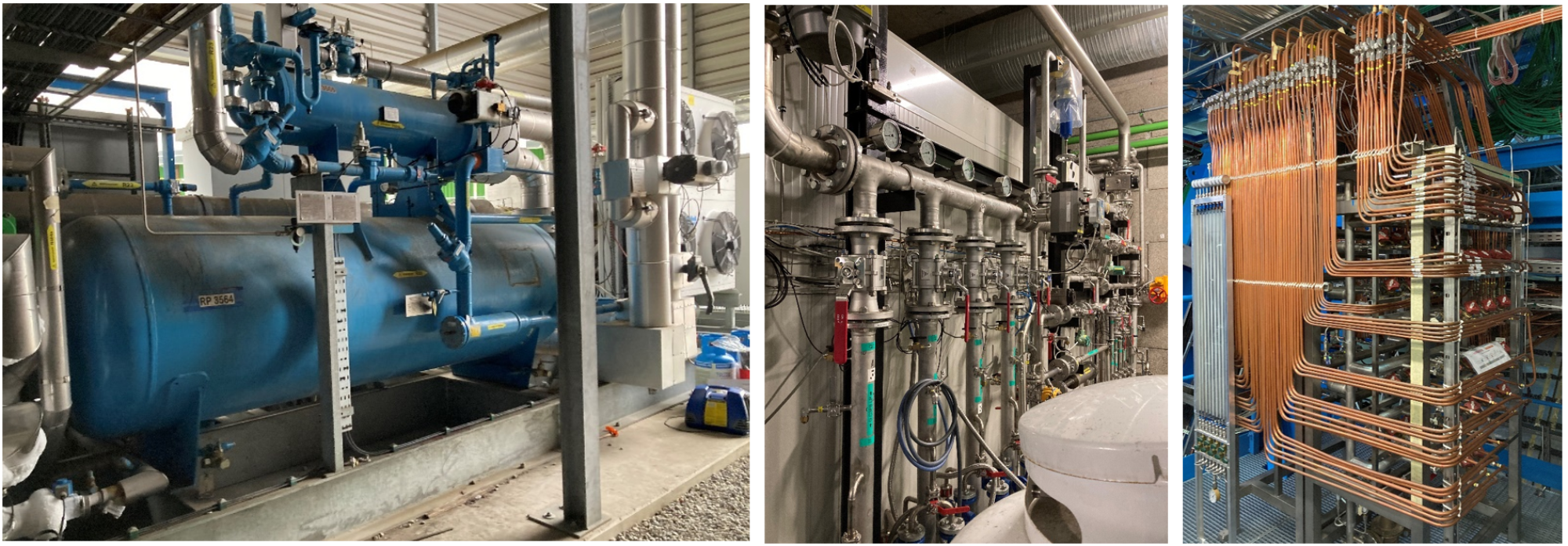
Discover CERN’s new F-gas e-learning and practical guidance webpages
| By HSE unit
In July 2024, CERN adopted its first Fluorinated Gases (F-Gas) Policy, which formalises its strategy to minimise the environmental impact of its installations and activities that use or contain F-gases, underlining the Organization’s commitment to reducing its direct (Scope 1) greenhouse gas emissions and to contributing responsibly to global climate action.
F-gases are essential to CERN’s cutting-edge research – they are used in a wide range of applications and equipment at CERN, including cooling, particle detection and electrical insulation. But they also come at a cost: F-gases account for some 90% of our direct (Scope 1) emissions. Reaching our ambitious goal of reducing Scope 1 emissions by 50% by 2030 implies that they be responsibly managed at all stages and levels.
To support this effort, CERN has published the F-Gas Policy Implementation Measures and launched a new F-Gas Fundamentals e-learning course and F-Gas Policy implementation: practical guidance webpages.
These resources will give all personnel involved with F-gases the tools to:
- understand what F-gases are and why they matter,
- learn how CERN manages them responsibly,
- recognise their own role in reducing emissions.
The F-Gas Fundamentals e-learning course is mandatory for all personnel handling F-gases, i.e. those involved in:
- procurement (including import where applicable), storage, transport, recovery, recycling or reclamation, destruction and/or final disposal of F-gases,
- installation, use and servicing, charging/refilling of equipment containing or using F-gases,
- monitoring (including leak checking and inspections), recordkeeping and reporting on/of F-gases and equipment containing or using F-gases.
This isn’t just about compliance – it’s about resilience. With F-gases becoming scarcer and more expensive, and with CERN’s research depending on them, adapting quickly is essential. Embracing better management, mitigation strategies and alternative solutions helps make CERN’s science sustainable.
View this story on home.cern.