
F-Gas Use Case: LHC Large Experiments, Other Experiments & Test Zones
Storage of F-Gas bottles/containers
| Requirements | Information |
|---|---|
Long term storage limited to: SF6 bottles:< 5 years Other F-Gas bottles: < 10 years | – Equipment seals deteriorate over time, compromising vessels’ leak-tightness – Transport of filled bottles is only permitted if the expiry date, indicated on the vessel, has not been reached |
Storage Mass limited to:
| For questions please contact f-gas-management@cern.ch |
Storage EAM registration | All Equipment containing F-Gas shall be declared and updated on the EAM platform (EAM or EAM light) according to the Monitoring chapter. |
Leak detection campaign | Leak detection campaigns shall be carried out at least annually on any stored bottles/reservoir and information kept up to date accordingly in EAM |
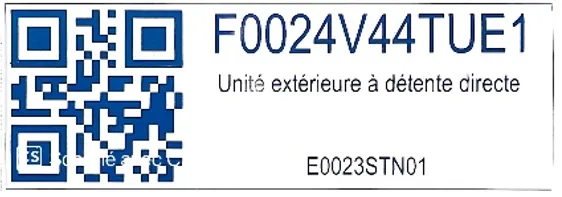
Bottles/vessels labelling | All Equipment shall bear a visible and durable label:
 |
Management & Monitoring
Equipment responsible persons shall ensure that the Equipment under their responsibility is duly registered together with its fluid information in the dedicated platform (EAM or EAM light).
Registration
The Equipment F-Gas information content must be specified in the Fluid Information tab. This tab is visible for every piece of Equipment already registered on the platform.
A step-by-step guide is available under the “Monitoring” chapter.
Annual Consumption
The overall annual consumption must be specified in Work Orders integrating the EXP_GAS task plan checklist by the installation (including Equipment) owner.
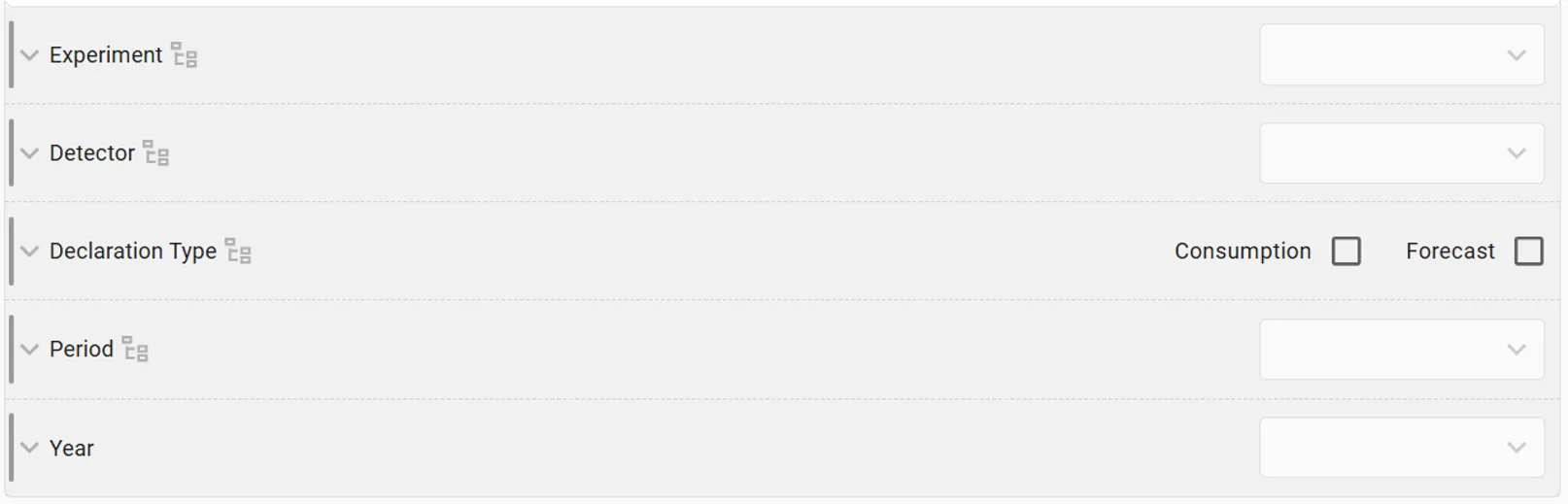
After selecting the Consumption for the Declaration Type, the Mode details appear.
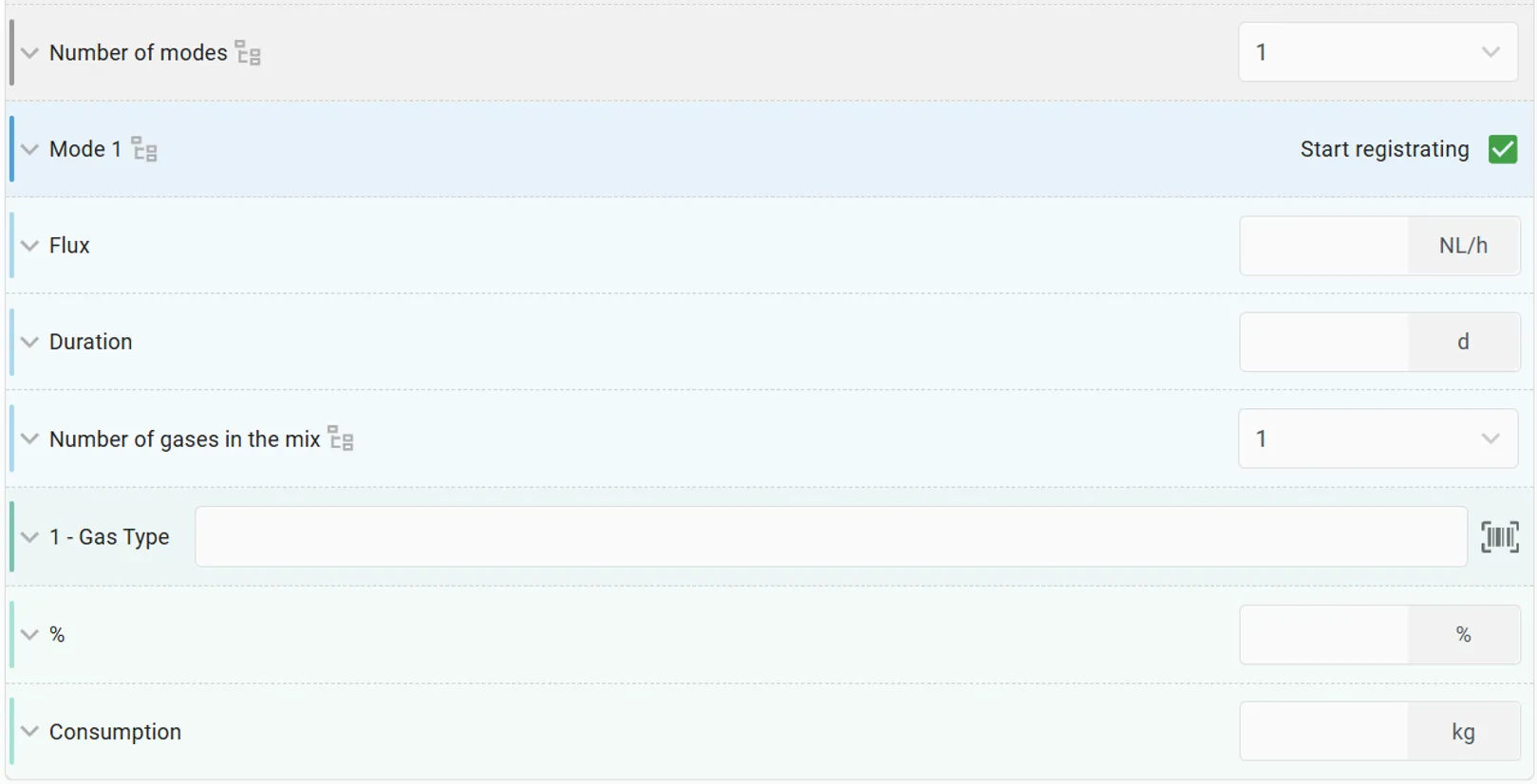
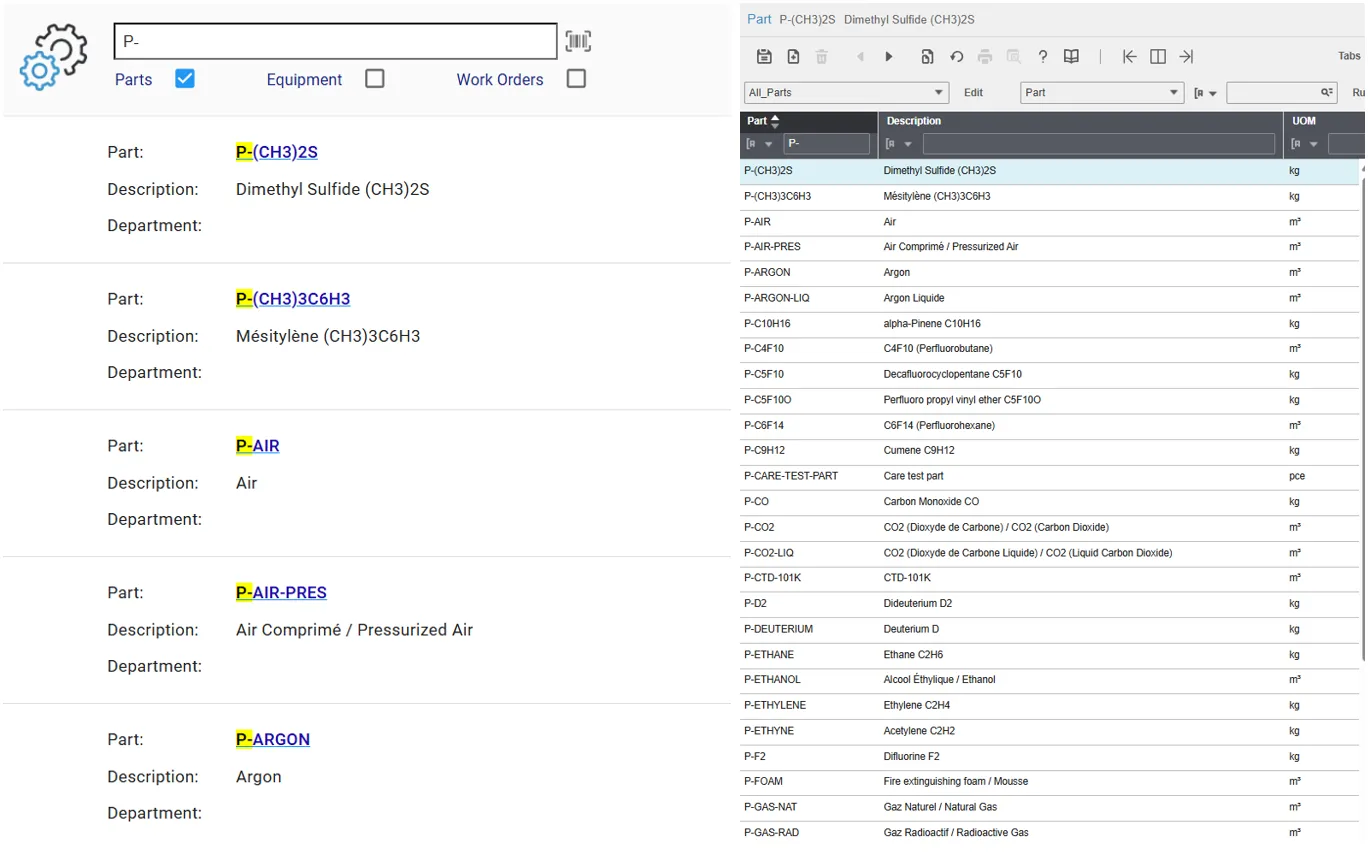
After specifying the Flow, Duration and Number of gases in the mix, enter the exact gas name in the mix in Gas Type. The name must be exactly the same as the Parts already registered in EAM.
The list of gas names in EAM can be found by typing “P-“ in the Parts search field:
For any additional issue encountered when completing the form, please contact f-gas-team-management@cern.ch.
For any technical issues, please contact eam.support@cern.ch.
Reporting extraction
F-Gas stock, emission and disposal will be directly extracted from the EAM platform for statistics and monitoring purposes by the F-Gas Management team.
Consumption Forecast (applicable to LHC Large Experiments)
Consumption forecast shall be communicated at least once a year by the technical coordinator to the F-Gas management team (f-gas-management@cern.ch), using the appropriate Excel template sent annually by the F-Gas Management team.
EAM Training
Several training courses to learn more about the EAM platform are available on the learning Hub.
Operation & Maintenance
Reminder: Personnel Handling F-Gases shall:
- complete the dedicated mandatory CERN e-learning course (LINK);
- receive CERN practical training if they are Handling research specific Equipment;
- hold the certifications required by applicable regulations in the Host Sates, if any.
Only duly trained personnel are authorised to make connections of F-Gases to Equipment. They shall verify the integrity of their connections.
Operation
Strategies to reduce F-Gas consumption/emissions (LHC Large Experiments)
In order to comply with the consumption/emission reduction principles set out in the F-Gas Policy and its implementation procedure, the technical coordinator of each LHC Large Experiment shall, in collaboration with EP-DT-GD gas team, assess the feasibility of installing one of the following options in all detectors in their experiment using F-Gases. The option depends on the gases present in the mixture and the specific characteristics and configuration of each detector:
- One step system: A gas recirculation system – the gases mixture passes through gas purification units before reinjection in the detector; a small fraction of fresh gas is added to compensate for the ventilated impure fraction.
- Two step system: A gas recirculation system followed by a gas recuperation plant – the mixture of gas captured from the gas recirculation system exhaust is sent to a dedicated separation plant to recover specific mixture components, or for any other reason.
Strategies to reduce F-Gas consumption/emissions (Other Experiments and Test Zones)
In order to comply with the consumption/emission reduction principles set out in the F-Gas Policy and its implementation procedure, the person responsible for the Experiment or Test Zone shall contact the EP-DT-GD gas team to assess the feasibility of installing a system adapted to their experiment configuration and type of gas mixture used, such as:
- A gas recirculation system: the gases mixture passes through gas purification units before reinjection in the detector; a small fraction of fresh gas is added to compensate for the ventilated impure fraction.
- A gas recuperation system: to recover the mixture of gas captured from the detector exhaust, either for the extraction of specific components of the mixture in a dedicated separation facility, or after compression for temporary storage or disposal (destruction).
Maintenance
| Instruction | Detail |
|---|---|
| Maintenance Procedure |
|
| Intervention Register | Any F-Gas movement (e.g. fill, recovery for reuse, disposal: recycling or destruction) shall be documented in the EAM entry of the Equipment |
Leak detection and repair
Please follow the recommendations applicable to each case:
| Specific Case | Leak detection | Repair | Control |
|---|---|---|---|
| Safely accessible Equipment | – Carry out the scheduled leak detection campaign (periodicity ≤ 1 year) | – Repair any leaks as soon as possible to limit emissions | Control the effectiveness of the repair as soon as technically and safely possible |
| Restricted access due to operations and safety risks | – Plan the leak detection campaign during the next scheduled shut down after safety clearance | – Schedule repairs for the earliest date that is technically and safely possible | |
| Immediate final repair is not possible | – Plan temporary leaks repair – Schedule the final repair date as early as possible | ||
| Freshly delivered bottles/containers with defects | – Check the bottle container with a sniffer refrigerant leak detector as soon as possible | – Inform the supplier as soon as possible of any leaks and/or inform CERN store as relevant |
F-Gas incidental/accidental release
Any Equipment responsible person shall develop a clear procedure covering accidental release events. The procedure must be stored in EDMS and cross-linked in the Equipment’s EAM entry.
Similar types of Equipment under the responsibility of the same person can refer to the same procedure.
The procedure shall be reviewed at least yearly in consultation with relevant stakeholders to ensure its practicality. Test drills with stakeholders to guarantee preparedness for quick and effective response shall also be performed.
The procedure shall at least include the following aspects:
| Category | Description |
| Means to stop or minimise gas leaks | List the available means/methods to stop the gas supply to the Equipment/installation/facility or to minimise the gas leak, as soon all safety conditions are met. |
| F-Gas loss Assessment | List possible means/methods to assess the total F-Gas quantity released during the incident/accident. |
| Mandatory Incident Declaration | The incident shall be declared in EDH (Incident Declaration) and shall include at least: – A brief, precise description of the incident/accident, – The actions carried out to manage the incident/accident, including those to minimise F-Gas loss, – The type and quantity (kg) of F-Gas or gas mixture emitted, – Any other relevant information to help avoid recurrence. The mandatory EDH Incident Declaration document shall be linked to the Equipment’s EAM entry. |
F-Gas Guidance Menu
CONTACT INFO
If you have any questions regarding the Policy, the Implementation measures, any feedback on this site or specific queries regarding fluorinated gases, contact the CERN F-Gas management team: F-gas-management@cern.ch
Chapter Version 1.0 (See all previous versions on EDMS)