
TSO Info Hub
A quick reference guide for the TSO community
TSO Meet-up recordings and presentations available under Support, Tools & Resources
This website is dynamic and will grow with your input and ideas.
Please don’t hesitate to share feedback with us on: hse-tso-webpage-feedback@cern.ch.
Your role as TSO or DTSO
Safety at CERN covers occupational health and safety, including radiation protection, the protection of the environment and the safe operation of CERN’s Installations, including radiation safety.
The Territorial Safety Officer (TSO) is an important Safety role at CERN. TSOs are appointed by Department Heads or Technical Coordinator of Large Experiments for buildings and premises under their responsibility. The TSO shall keep themselves and the DSO(s) or LEXGLIMOSes to whom they report informed regarding all aspects of Safety related to their allocated buildings and premises. The full TSO Mandate is defined in the General Safety Instruction GSI-SO-2.
The following video provides an overview of the TSO role, through the experiences of four TSOs, each working on very different types of building.
The mandate, details of appointed TSOs, and other safety roles, can also be found in Roles.
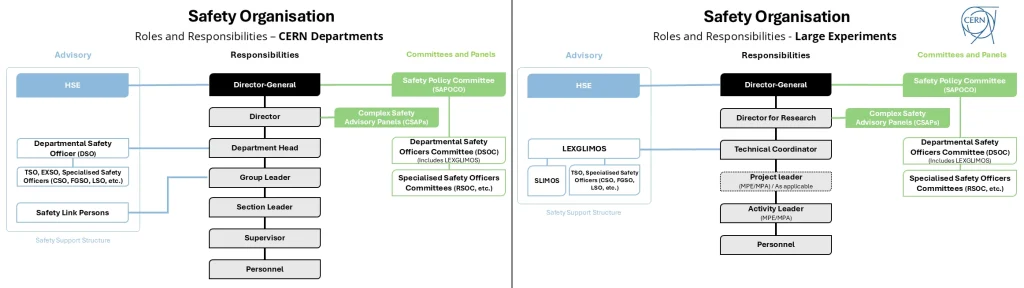
Click the above image to view it in full size. Download the individual charts from resources below.
Key documents
We advise you to consult the HSE webpages and Safety related webpages of your Department/Large Experiment regularly.
You will find some key documents that you should familiarise yourself with below.
CERN
- CERN Safety Policy
- CERN Safety Rules
- Declaration of safety incidents
- CERN Safety Fundamentals
- Safety Risks
- CERN Safety FAQ
- Heatwave action plan
Get acquainted with the environmental aspects of Safety at CERN: read more about CERN’s commitment to environmentally responsible research on: https://home.cern/about/what-we-do/environmentally-responsible-research
Host State Regulations
Host States’ relevant laws and regulations apply on a territorial basis where CERN has not established Safety Rules. Contact your DSO/LEXGLIMOS or HSE in case of doubt.
Click to expand lists
Geneva Regulation
France
Standards in English, French or German published by SNV, IEC, SIA, Electrosuisse and ISO) can be accessed via CERN’s Scientific Information Service on SNV Connect.
To access these: Click on Login, Select “Microsoft 365” under “external login”, Connect with your CERN account.
FAQ
Unless otherwise specified, references to the TSO below also apply to the Deputy TSO (DTSO) when acting in that role.
What is a TSO, who they report to, and how are they appointed?
A TSO is a Safety Officer appointed to support the relevant Department Head or Technical Coordinator, through the DSO or LEXGLIMOS, in fulfilling Safety obligations for specific buildings and premises. The TSO acts on behalf of the relevant DSO or LEXGLIMOS and reports to them, as applicable.
Regarding appointments:
Where buildings or premises are shared, the relevant parties shall be involved in the appointment: Department Heads agree on a common TSO in consultation with their DSOs; for Department–Large Experiment sharing, the Department Head appoints the TSO in consultation with the DSO, Technical Coordinator and LEXGLIMOS.
Each appointment shall be made in writing, specifying the mandate and the buildings and premises concerned.
For buildings and premises under the responsibility of a Department, the TSO is appointed by the Department Head, in consultation with the DSO, from among employed Members of the Personnel of the Department.
For the experimental areas of a Large Experiment, the Technical Coordinator appoints the TSO from among Members of the Personnel participating in the Large Experiment, in consultation with the LEXGLIMOS and the Department Head of the TSO or, if the TSO is an associated Member of the Personnel, their home institution.
Do TSOs need a deputy?
Yes, each TSO shall have a deputy who replaces them in their absence. It is recommended that they work together as a team to share workload and experience.
What is the physical scope of TSOs?
The physical scope of the TSO corresponds to the buildings and premises for which they have been formally appointed. In other words, the TSO has a territorial scope: they are appointed for a given building or area, not for an activity, equipment or a specific risk. Within this scope, the TSO’s routine follow-up primarily concerns common, shared or circulation areas, i.e. areas used by several people, groups or services, and which are not exclusively assigned to a specific activity or responsible person. This can typically include Safety-relevant aspects of:
- corridors; staircases; roofs;
- sanitary facilities for Safety-relevant issues affecting users or the building;
- meeting rooms; copy room;
- break room, kitchen, cafeteria, refectory, generally in support of the Location Responsible, where one has been appointed;
- access routes to and from the building, including emergency exits and evacuation paths;
- more generally, rooms or spaces that can be used by all occupants;
The TSO is not the direct responsible person for spaces assigned to an activity, equipment or a specific risk. In particular, routine TSO follow-up does not normally cover:
- offices; laboratories; workshops; technical or experimental areas;
- areas presenting specific risks for which, in principle, another responsible person has been appointed, for example a Location Responsible, a Workshop Supervisor or an activity leader.
These spaces remain under the responsibility of their users or specific Safety responsible persons, while remaining in interface with the TSO for general building-related aspects.
Parking areas are generally outside the TSO’s routine building follow-up and usually managed by SCE. However, the TSO may still raise, or relay Safety concerns observed in these areas, especially when they affect access to the building, evacuation routes, assembly points or interfaces with the building.
Is there a dedicated training for TSOs?
Yes, there is a 2-day classroom course which all new TSOs shall do before being appointed. There is no refresher course but long standing TSO’s are welcome to do the TSO course as it is updated from time to time with the latest regulations and practices.
Do TSOs have their own budget code, and what should they do when one is required?
Budget arrangements depend on the internal policy of each Department or Large Experiment and should be communicated to the TSO. Many CERN services can be requested without a budget code. Where a budget code is required, the TSO should seek support from the DSO/LEXGLIMOS, who may involve the Department Head, Technical Coordinator or Space Manager as appropriate.
What shall the TSO do in an emergency?
In an emergency, the TSO, like everyone at CERN, must first ensure their own safety, avoid putting themselves at risk and follow the applicable emergency instructions. Everyone is also expected, where this can be done safely, to raise the alarm, assist people in difficulty and warn others of an immediate danger.
The TSO’s additional role in specific emergency situations is described below.
Major incident with CERN crisis management activated: the TSO may be asked to contribute, for example by providing local building information or supporting communication.
Fire, smoke or evacuation alarm: Once the assembly point reached, gather relevant information from the emergency guides and report it to the Fire Officer.
Why does the TSO have to sign certain IMPACT requests related to their building? What is their responsibility?
The TSO is involved in IMPACT requests relevant to the buildings or premises for which they have been appointed, so that they are informed of planned activities and can identify any potential impact on the building, common areas, access routes, evacuation arrangements or other ongoing activities.
If the TSO identifies a risk of co-activity or a potential conflict between several activities, they should alert the persons concerned and facilitate contact between them. The TSO therefore acts as a territorial point of contact, without taking on the coordination of the activities or responsibility for their execution. Typical situations in which the TSO may need to react include, for example:
- two or more activities taking place in the same area where they may interfere with each other, for example work at height above another activity or lifting/handling operations close to people working below;
- transport or movement of large or heavy equipment through or close to an active work area;
- an activity affecting access, circulation or evacuation arrangements needed by other occupants or activities.
In such cases, the TSO is not expected to assess or coordinate the technical aspects of the activities themselves. Their role is to flag the potential interface and ensure that the relevant responsible persons are put in contact. When reviewing an IMPACT request, if there is any doubt about possible co-activity, it is good practice to check the planning of other activities in the building in IMPACT before signing the request.
The TSO’s involvement in IMPACT does not transfer responsibility for the activity to them. The activity remains under the responsibility of the persons or entities responsible for its organisation and execution under the applicable process.
Is the TSO responsible for organising planned evacuations in their building?
The formal responsibility for implementing the planned evacuation procedure lies with the DSO/LEXGLIMOS. For each building or infrastructure identified as a priority, the DSO/LEXGLIMOS appoints an organiser, who is responsible for coordinating the planned evacuation throughout the procedure.
The TSO acts as a local reference person for the building or premises concerned. Depending on the case, they may support the organiser by providing knowledge of the building, helping to identify existing or required emergency guides, contributing to the update of the emergency guide list. Together, the TSO and the organiser perform the preparatory visit of the building or infrastructure and implement the necessary corrective actions.
The TSO is involved in the preparation and execution of a planned evacuation, and their input is often valuable. However, they do not automatically carry the responsibility for organising it. They only take on the organiser role if this has been explicitly assigned to them by the DSO/LEXGLIMOS.
By way of indication, the corresponding procedure can be found in EDMS: https://edms.cern.ch/document/2254068/
What is the difference between a tertiary building and a machine building and how to differentiate them?
At CERN, the terms “tertiary building” and “machine building” are often used in an operational context, in particular to identify which service is responsible for maintenance or technical support.
For tertiary buildings, maintenance requests are usually handled by the SCE Department. In machine buildings, technical systems such as electricity, lighting, and ventilation are usually maintained by the EN Department. The distinction is important for TSOs because the right support service depends on the category and use of the building. To determine the type of a given building:
Click on “Data” and select “Thematic map/Tertiaire-Machine”
Go to gis.cern.ch
How should a TSO exercise their authority?
The TSO is given the authority and means needed to fulfil their mandate for the buildings and premises for which they are appointed. To exercise this authority effectively, the TSO shall keep themselves informed regarding Safety matters related to the buildings and premises concerned, including relevant interfaces with activities taking place there. This authority should be understood as the ability to act when a Safety matter may affect the building, common areas, interfaces between activities, access, evacuation routes or the people present.
It does not mean that the TSO becomes responsible for activities taking place in the building, or replaces the persons responsible for the activity, the DSO/LEXGLIMOS, HSE or any specialised Safety role.
In practice, the TSO may use their authority to:
- request additional information about an activity planned in the building;
- ask who is responsible for the activity, equipment or risk concerned;
- request clarification on access, evacuation, coactivity, impact on common areas or interfaces with other occupants;
- ask that the relevant responsible persons to be put in contact;
- raise the need for a VIC, or another coordination step, where applicable;
- escalate to the DSO/LEXGLIMOS if the situation is unclear or may present a risk.
The TSO’s authority supports their role of remaining informed about Safety matters related to the buildings and premises concerned, keeping relevant people informed, collaborating with those responsible for equipment and activities hosted there, and contributing to Safety follow-up. When works or services are involved, the TSO may raise concerns or request clarification, but formal Safety coordination remains with the persons or entities designated under the applicable Works and Services process.
Who ensures that a building has enough Emergency Guides?
Overall Safety responsibility remains with line management, supported by the DSO/LEXGLIMOS. In practice, the TSO is expected to manage Emergency Guide coverage for the buildings and premises for which they are appointed. This includes keeping the assignments up to date in ROLES, nominating or revoking Emergency Guides as needed, and identifying gaps resulting from changes in occupancy or building use.
The DSO/LEXGLIMOS provides support where needed, in particular where sufficient coverage cannot be achieved locally or where several Departments or Large Experiments share the same premises.
The appropriate number and distribution of Emergency Guides should take account of the building’s use and foreseeable occupancy. Emergency Guide coverage is also reviewed during the preparation of planned evacuations, in collaboration with the organiser, the TSO and the DSO/LEXGLIMOS.
Sauf indication contraire, les références au TSO ci-dessous s’appliquent également au TSO adjoint (DTSO) lorsqu’il exerce cette fonction.
Support, Tools & Resources
As TSO you report to the DSO(s) or LEXGLIMOS(s) of the Department(s) or Large Experiments responsible for the building(s) or premises for which you have been appointed. The DSO(s)/LEXGLIMOS(s) are also your primary support. They can provide mentorship, specific information, and act as a partner in troubleshooting safety matters.
Click the titles below to see the full list of tools and resources available to assist you.
CERN Service PortalCreate a ticket, find key contacts, knowledge base (safety and health) etc. | GIS PortalFind a building, room, or road. View key data including safety features, assembly points, key personnel locations, pictures, noise risk, chemicals, and much more. | ImpactAllows management of activities, VICs, alarms (IS37), lock-outs, fire permits, DIMR radiation risk assessments, dose planning etc. |
ADAMSCERN’s platform for controlling access to facilities, buildings etc. | EDMSAccess to reports: safety inspections (buildings, electrical etc.), evacuation plans, L3 alarm acceptance reports etc. Enter the building number in MTF: the “Document” and “Operation” tabs give access to the reports. | RolesFind the different safety roles at CERN including their mandates as well as other roles at CERN. Safety roles have been tidied up and now provides updated information. Please take the time and do the tutorial to easier find what you need. |
Incident FormAny person involved in-, witnessing or who becomes otherwise aware of a safety incident shall fill in the incident form within 24 hours of the incident or becoming aware of the incident. As TSO you should report any accident (including incidents with material – or environmental damage), near miss or hazardous situation in your building. The form allows monitoring and analysis of safety incidents to understand and improve safety at CERN. | Occupational Accident Form (EDH)To protect members of personnel against financial consequences from occupational accidents, illness or incapacity for work. The declaration must be created within 10 working days or 3 months if materially unable to meet the deadline. Accidents when commuting, on duty travel, home leave etc. may also be occupational accidents. This is determined by HR on receipt of the form. | CERESManagement of chemicals. To be updated upon changes or minimum once per year. |
SAILOR ResolverFor CERN personnel in charge of solving safety remarks for general safety (buildings) and electrical installations (introduced in 2024). | SAILOR Safety ReportingFor CERN safety managers to access safety inspections for buildings, lifting equipment & electrical installations (resolver not implemented yet). View CERES statistics. Useful to TSOs for overview and filtering capability. | RAISINUsed by HSE-RP to manage the radiological classification of any location at CERN. Useful for CERN personnel to consult the classification. Consult the learning hub RP awareness training for further information. |
HSE WebpagesFind out more about the HSE department and its respective groups ENV, FRS, OHS, RP, TS, Medical Service. | SCE – Request for road markup (Demande de balisage)Fencing and signage. Traffic controller. | WasteWhat goes where? |
EAM ToolsEAM & EAM light tools for asset management and maintenance, and the administration of work orders, etc. For example, EAM is used to manage: | CERN Safety FAQA database of answers to common questions, sorted by theme. | CERN Fluorinated Gas policy implementation: practical guidance pagesComprehensive guidance supporting the implementation of the CERN F-Gas policy and its associated implementation measures. |
Locations (locations.cern.ch)Provides structured information about CERN buildings and rooms. The “Buildings – Safety details” interface under “Reports” provides an efficient way to identify TSOs for a given Department or to list the buildings assigned to a given TSO, or a given department. |
This section is in development. If you have an idea for something to include, please send your suggestion to hse-tso-webpage-feedback@cern.ch
Managing incidents & works
- CERN Safety FAQ – A great quick reference guide for common queries
- EDH Incident Declaration Form
- HSE Safety Risks webpages – for detailed info on a given hazard
General Safety Information and Prevention
- Safety Training Courses on Learning Hub
- CERN Safety Fundamentals
- Poster: General Safety Poster – key contacts & info at a glance
- Poster: Incident, accident, medical emergency: what should I do?
- Waste Management Posters: Light version / Detailed Version
- Poster: What to wear: Required PPE in beamline areas poster
- Poster: Become an Emergency Guide poster to assist recruitment
- Poster: Are you Trained and Ready for LS3?
- Poster: Life Saving Actions Training
- Pharmacy / First-Aid cabinet contents list and order form – SCEM 54.99.80
- Video: Managing and Reuse of Waste at CERN
- Video: Safety at CERN (EN) / La sécurité au CERN (FR)
- Video: CERN and the Environment
- Video: Energy Saving Measures (EN) / Mesures d’économie d’énergie (FR)
Specific Hazards or Risks
- HSE Safety Risks webpages – for detailed info on a given hazard
- Laser Risk: Do not use lasers above Class 1 poster for meeting rooms etc.
- Laser Risk: Buy compliant laser pointers at CERN stores – SCEM 54.21.50.001.7
- Radioactive Waste Video: Radioactive Waste Disposal (EN) / Élimination des déchets radioactifs (FR)
- Self-rescue Masks: Bulletin information regarding new Self-rescue masks, Dezega CARBO30.
- Smoking: Notification/prohibition posters (EDMS 3305415)
TSO Meet-up Resources
Find the presentations and recordings of previous TSO meetup events on the indico links below:
- 2025 – First TSO Meet-up featuring Testimonials, Safety Culture, Safety Incident Management & SCE
- 2026 – Second TSO Meet-up featuring DG, SCE, Communications, Electrical & Fire Safety
We look forward to welcoming you to the third TSO Meetup in 2027.
Training
Safety courses which could be useful for you and for the occupants of your building(s) and premises. If you have not received appropriate training, speak to your DSO/LEXGLIMOS(s).
In an Emergency
In case of emergency or incident, call:
Never transport an injured person yourself
Trigger the evacuation alarm if required, and alert others, where it is safe to do so.
Outside emergency situations, if you wish to contact the CFRS please use the admin line: +41 22 767 4848.