
Safety Risks – Fire Safety
Contents
Introduction | Regulatory Framework | Useful Contacts | Fire Dynamics | Recommendation: Safety Starts with you | FAQ & Resources
Introduction
Fire is a hazard that concerns everybody at CERN. When it comes to fire safety, everyone plays a role. From the Fire Safety Engineering team and the project engineers involved in design and construction, to the CERN Fire and Rescue Service, and even the everyday occupants of the buildings. Fire safety must be ensured at every stage of a building’s life, from the preliminary design, through construction and everyday use, all the way to its deconstruction.
Fire Safety is pursued at CERN throughout the following phases:
- Fire safety designs: many factors can influence fire risk, as well as the potential impact of a fire, including the type and number of occupants, the building’s layout, the activities performed, the presence of hazardous or combustible materials, and the available safety systems. A fire risk assessment evaluates all these elements and defines the most appropriate strategy to reduce and control the risk. The fire safety design can follow two approaches:
- Prescriptive: directly compliant with the host‑state’s codes and standards.
- Performance based analysis and/or Quantitative Risk Assessment. Advanced alternative methods to demonstrate that equivalent or superior safety levels are achieved.
- Execution compliance: verifying that all fire‑safety requirements are correctly implemented.
- Maintenance and inspection: regular inspection, testing, and maintenance of fire‑safety systems to ensure performance.
- Organizational measures. Ensuring that fire safety is maintained through day‑to‑day practices.
- Evacuation procedures: facillitate the safe evacuation of all occupants.
- Safety culture: good practice involves maintaining safe conditions and avoiding behaviours that could increase fire hazards.
Regulatory framework
At CERN, fire safety is designed in accordance with the host‑state legislations, whether the buildings are located in France or Switzerland, as well as the applicable CERN guidelines. Additional international regulations are followed when relevant. The main regulatory framework generally followed at CERN for fire safety are:
- CERN Rules & Guidelines. All CERN fire safety guidelines can be found here. These are currently being reviewed and updated.
- Code E: Fire protection.
- IS41: Use of plastic and non-metallic materials at CERN with respect to fire safety and radiation resistance.
- SSI-FS-2-1: Fire Safety and Radiation Resistance requirements for Cables.
- Guideline on Safe charging of Li ion Batteries at CERN.
- Swiss Codes
- VKF AEAI 2015 : existing Fire Safety prescriptions.
- VKF AEAI 2026 : new risk-based revision to enter into force in 2027.
- OLT 4 - Ordonnance sur la Loi du Travail. Additional fire‑safety requirements for workplaces and industrial facilities.
- French Codes
- European Standards for Fire Safety
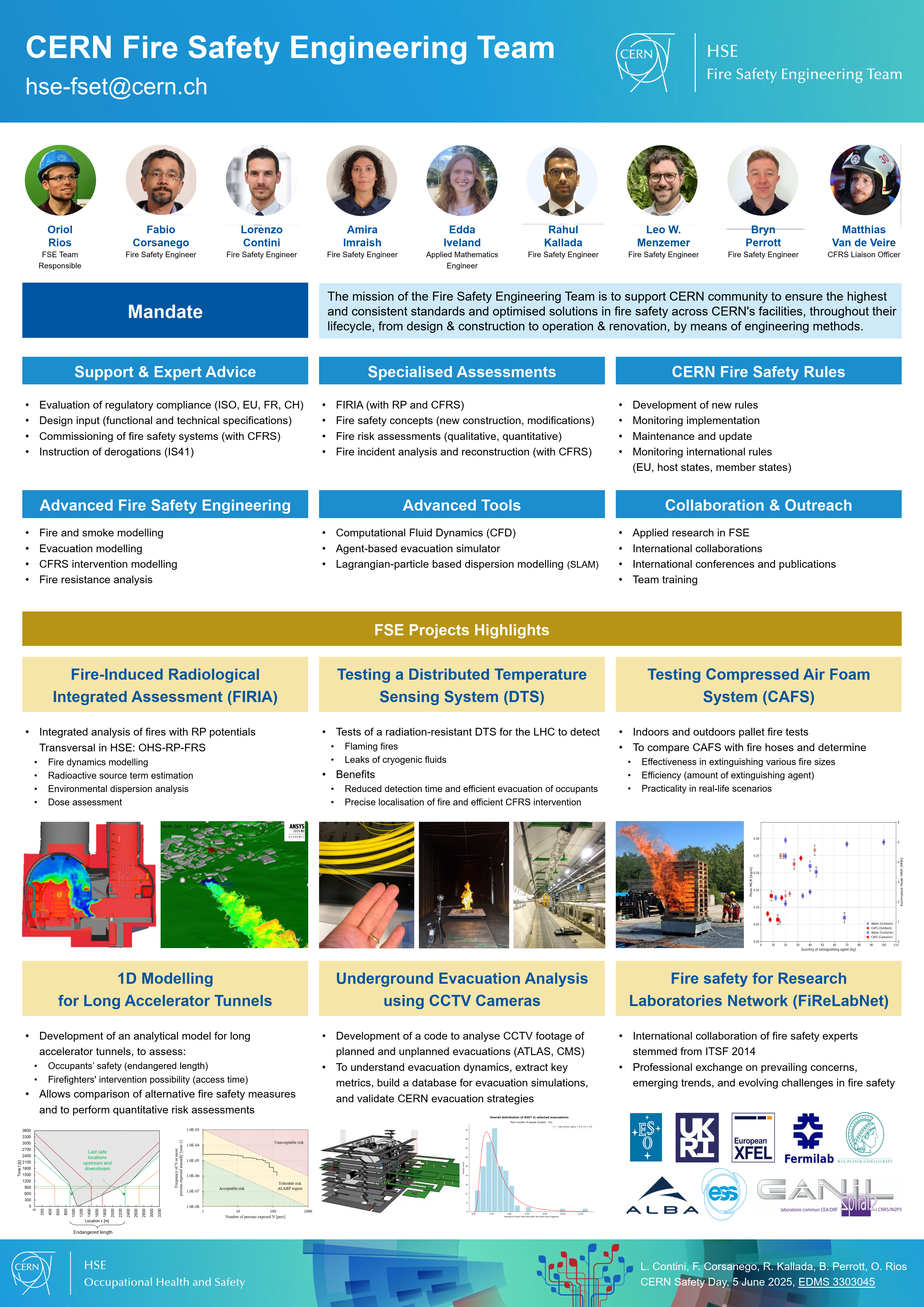
Useful ContactsThe mission of the Fire Safety Engineering Team is to support the CERN community by ensuring the highest and most consistent fire‑safety standards and deliver optimized solutions across all CERN facilities. See the poster opposite for more details. How to reach us:
|
|
Fire Dynamics
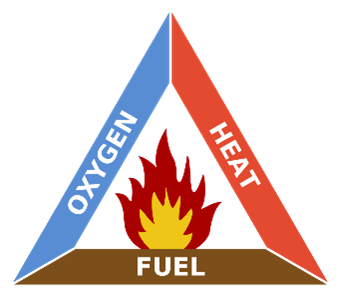 Fire dynamics is a complex field that explains how fires start, spread, develop, and eventually decay. A fire can only ignite and sustain itself when the following three elements are present:
- Fuel: a combustible gas present in sufficient quantity for sustained burning.
- Oxygen: supports combustion by reacting with the fuel; present in sufficient quantity for sustained burning.
- Heat: an ignition source that initiates the thermal decomposition of the fuel. This can come from a spark, a small flame, a hot surface, or other heat sources.
For a fire to ignite and spread, a sufficient ignition source is required, along with a well‑mixed combination of fuel and air within the flammability limits. If any one of these components is absent, a fire cannot start or continue to burn.
Fire spread is understood and evaluated through two aspects: how materials ignite and contribute to flame and smoke (reaction to fire), and how long building elements can contain heat, smoke, and flames within a compartment (fire resistance). Together, these performances determine both how a fire develops on material surfaces and how effectively it is prevented from spreading between areas.”
Perception of Risk. How fast can a fire spread?
Fire growth and development is not linear; it accelerates rapidly and often exponentially. This is why early detection and alarm activation with immediate evacuation are critical. If, during an emergency, you notice any fire indicators, such as smoke or flames, do not underestimate how quickly conditions can deteriorate.
Most fire-related injuries and fatalities are caused by smoke inhalation and exposure to toxic gases. To mitigate these risks, CERN Safety Instruction IS41 promotes the use of materials and products with reduced smoke and toxic gasses production.
The video below shows how quickly a typical fire in a storage or office space can spread.
Reaction to fire
The reaction to fire performance measures how a specific material contributes to the growth and spread of a fire. It is typically classified using the European Euroclass system (compulsory for Construction Products (CPR) in EU). IS41 also mentions and recognizes additional standards for non CPR products.
The reaction to fire behaviour of a material, according to EN 13501-1, can be described by:
- Contribution to the fire (classes from A to F): in terms of ignitability, heat release rate of a product and flame spread, where A1 materials are incombustible and do not contribute to a fire.
- Smoke production (classes from s1 to s3): indicates the quantity and density of smoke produced, where s1 is the class with the least production of smoke.
- Droplet production (classes from d0 to d2): indicates whether burning droplets are produced and contribute to fire spread, where d0 represents the class with no (or the least) production of droplets.
Each of these parameters can influence how a material contributes to a fire and its propagation. Choosing materials that contribute less to ignition and flame spread, that produce minimal smoke, and few or no burning droplets, results in smaller, slower‑developing fires, reduced smoke generation, and a lower risk of the fire propagating to adjacent materials.
For example, according to SSI-FS-2-1 and EU Regulation 2024/3110 (CPR), the reaction to fire class admitted for cables at CERN are:
- For High Risk Installations the fire performance shall be at least Cca-s2,d1,a2
- For Low Risk Installations the fire performance shall be at least Dca-s2,d1,a2
The new CPR 2024/3110 came into force on January 8th, 2026, and partially repeals CPR 305/2011. It will fully replace the previous regulation on January 8th, 2040. During this transition, both regulations will coexist.
Fire Resistance
Fire resistance measures the ability of a complete system (like a wall, floor, or door) to act as a barrier and maintain its integrity for a specific duration, usually expressed in minutes. It is defined by three main criteria (REI):
- R: Load-bearing capacity: the capacity of a structural element to withstand the mechanical effects of fire and maintain its stability.
- E: Integrity: the ability to prevent flames and hot gases from passing through the element.
- I: Insulation: the ability to limit heat transfer through the element.
These classifications are always linked to a time rating, typically classified for 30, 60, 90, 120, or 180 minutes.
Structural components such as columns, beams, and slabs are typically classified as REI because each factor is crucial to their function. Other elements, such as non-load‑bearing partitions, fire doors, seals, and dampers, are typically classified as EI as they do not typically need to support a load.
Elements with a certified fire resistance are essential for creating fire compartments, which can:
- Prevent the spread of fire from one area to another
- Limit the maximum possible fire size
- Separate zones with different hazard levels
- Support safe and controlled evacuation
This is why it is important to always maintain compartmentation, both during normal operation and emergencies.
Recommendation - safety starts with you
Fire safety is ensured by being prepared, properly trained, and by following operational measures that promote a strong safety culture.
- Be prepared
- Save the CERN Fire and Rescue Service (CFRS) number in your phone: +41 22 76 74444 (from a CERN phone: 74444)
- Familiarise yourself with the building layout and evacuation plans. Be aware of your nearest escape routes.
- Follow the necessary and mandatory training courses.
- Evacuation procedures
- If you see any signs of fire, such as smoke and flames, call CFRS and, if available, manually trigger the fire alarm at the nearest safe alarm point.
- When alerted to a fire, whether by the alarm system, visible signs of fire, a colleague, or Emergency Guide, evacuate the building immediately and calmly.
- Do not stop to collect your personal belongings.
- Close windows and doors and exit the office, but do not lock them. This will help limit the fire and smoke propagation.
- Follow the evacuation signs and alert others on your way. Use the nearest safe exit.
- In surface buildings always take the stairs to evacuate. Do not use the lifts.
- In certain underground areas, such as the experimental caverns, you MUST use the lifts to evacuate. Always ensure you know the evacuation procedure for the underground area you are working in (re-take the safety training if you have doubts).
- Go to the assembly point and wait there. Do not re‑enter the building until the CFRS gives clearance. Do not leave the assembly point. Missing people may prompt rescuers to enter a hazardous area to search for you, putting their lives at risk.
- Maintain a safe environment
- Do not block open or close fire resistant doors, escape routes and emergency exits.
- Keep your workplace clean. Only store the minimum amount of material requred for your activities. Store materials safely (e.g. chemicals), and dispose of them when no longer needed to prevent the accumulation of combustible material.
- Keep evacuation routes free of any obstructions, such as furniture or temporary stored materials. Emergency paths must be cleared from obstacles.
- For any hot works, submit a Fire Permit.
- No naked flames are allowed.
- Safely use portable heaters at CERN.
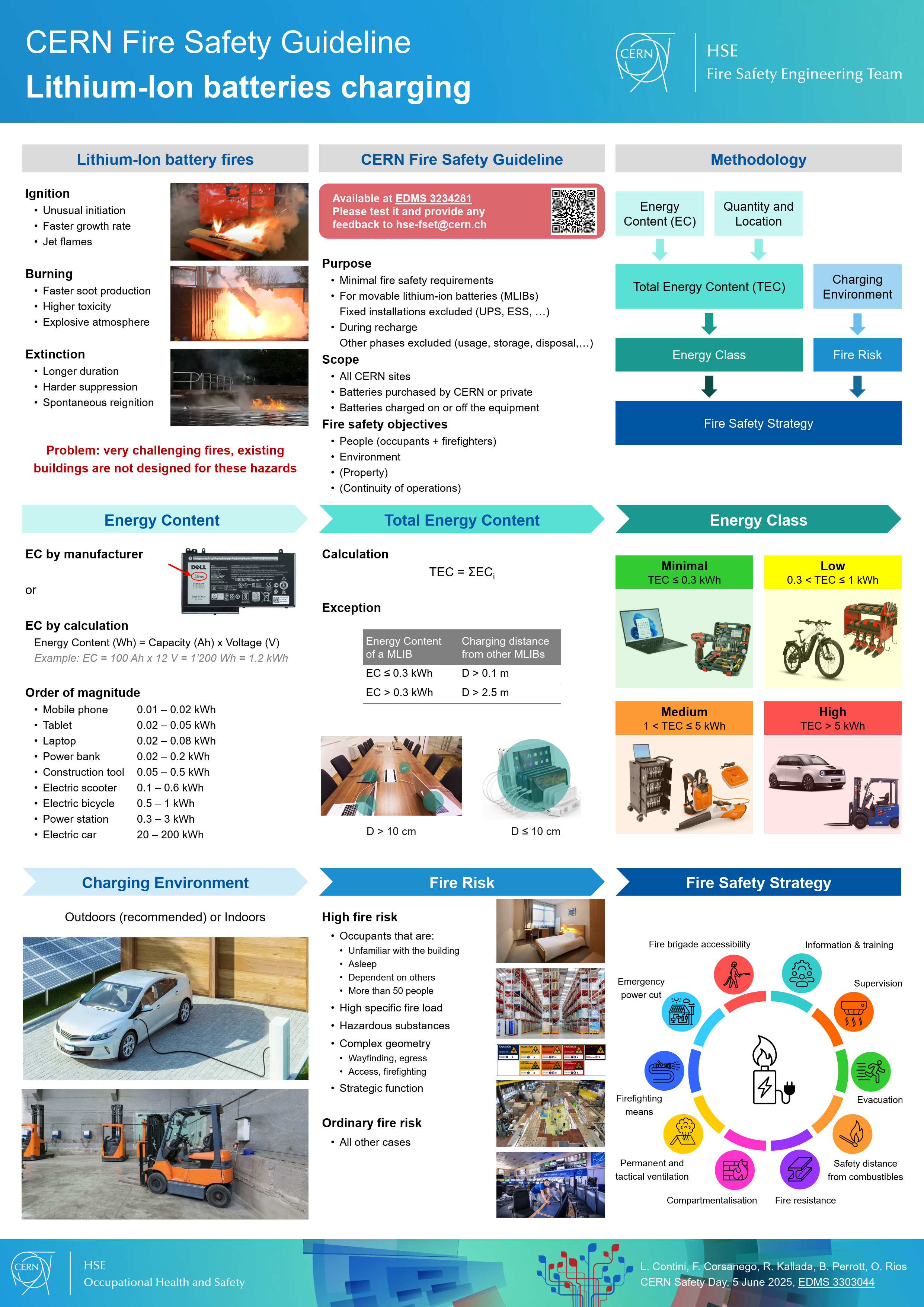
- Follow the guideline for Fire safety measures for lithium-ion batteries charging (summarised in the poster below)
- In case of maintenance and interruption of a safety system, submit an IS 37.
Safe charging of Lithium Ion Batteries:
FAQ & Resources
Frequently asked questions on the matter of fire safety can be found here.
Fire Extinguishers
Fire extinguishers should be requested via the CERN Fire and Rescue Service: contact Miikka Leinonen.
- There is a list of available extinguishers on CERN stores.
Resources
- Poster summarizing the guideline on Lithium Ion Battery charging at CERN
- Notice on the use of Portable Heaters at CERN
Fire Safety and Evacuation Signage can be found in the CERN Stores safety catalogue under SCEM 50.55.