Safety risks – Pressure Equipment
Introduction
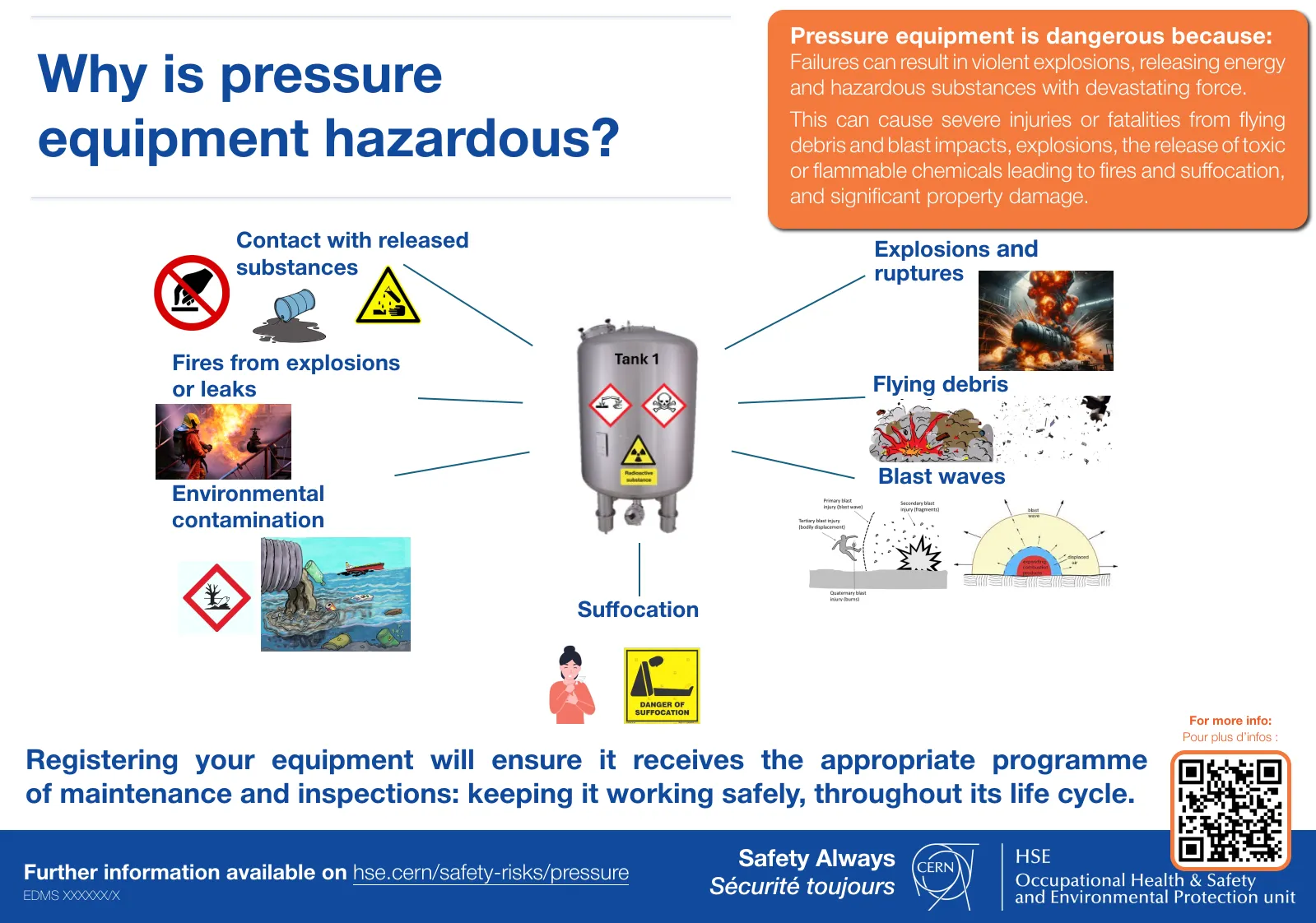
CERN uses pressure equipment in a range of activities, both industrial and experimental. Pressure equipment means vessels, piping, safety accessories and pressure accessories, including, where applicable, elements attached to pressurised parts, such as flanges, nozzles, couplings, supports, lifting lugs etc. See definitions below for the legal definition.
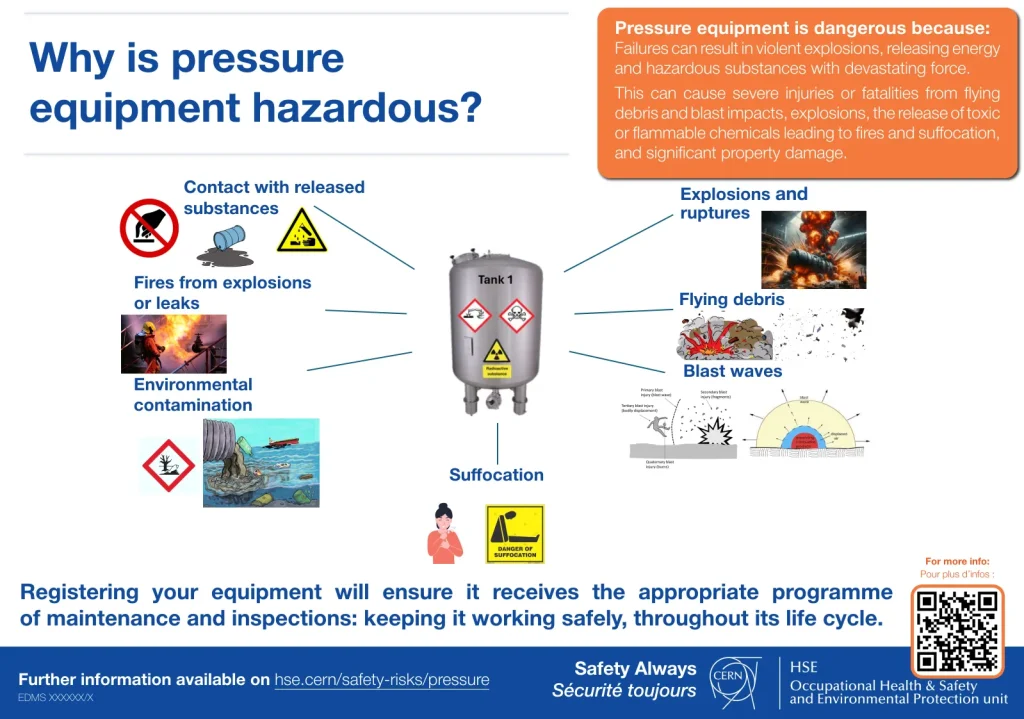
Risks arise both from the energy present in systems under pressure, and the specific chemical hazards posed by their contents. Information on chemical safety can be found here.
As an equipment owner/user of pressure equipment, you are responsible for its design, its safe operation, maintenance and periodic inspection.
Ensure you have followed the below tutorials and read the related regulatory documents.
In case of emergency or incident (failure, spill, leak), call the CERN Fire & Rescue Service on +41 22 76 74444.
Regulatory framework
The complete regulatory framework associated to pressure equipment and cryogenic equipment is available on this link. In particular:
These define the minimum Safety requirements applying to all mechanical equipment belonging to or hired by CERN or the collaborating institutes, used or intended for use at CERN, and to all associated activities.
This defines the minimum Safety requirements applying to all non-cryogenic standard pressure equipment and accessories belonging to or hired by CERN or the collaborating institutions, used or intended for use at CERN, and to all associated activities. It does NOT apply to: fire extinguishers; pressure equipment used with an open-flame; heating, ventilation and air conditioning (HVAC) equipment; cryogenic equipment.
This defines the minimum Safety requirements applying to all cryogenic equipment and accessories belonging to or hired by CERN or the collaborating institutions, used or intended for use at CERN, and to all associated activities.
The following Specific Safety Instructions (SSIs) define specific Safety requirements in addition to those defined in the GSI-M-2 for one specific subset of pressure equipment:
- SSI-M-2-1 “Pressure vessels”
- SSI-M-2-2 “Simple pressure vessels”
- SSI-M-2-3 “Safety accessories for standard pressure equipment”
- SSI-M-2-4 “Metallic pressurised piping”
- SSI-M-2-6 “Transportable Pressure Equipment”
Definitions
CERN Nomenclature follows the PED standards, as below:
Click to expand the list
- ‘Pressure equipment’ means vessels, piping, safety accessories and pressure accessories, including, where applicable, elements attached to pressurised parts, such as flanges, nozzles, couplings, supports, or lifting lugs.
- ‘Vessel’ means a housing designed and built to contain fluids under pressure including its direct attachments up to the coupling point connecting it to other equipment; a vessel may be composed of more than one chamber.
- ‘Piping’ means piping components intended for the transport of fluids, when connected together for integration into a pressure system. It includes in particular a pipe or system of pipes, tubing, fittings, expansion joints, hoses or other pressure-bearing components as appropriate; heat exchangers consisting of pipes for the purpose of cooling or heating air shall be considered as piping.
- ‘Safety accessories’ means devices designed to protect pressure equipment against the allowable limits being exceeded, including devices for direct pressure limitation, such as safety valves, bursting disc safety devices, buckling rods, controlled safety pressure relief systems (CSPRS), and limiting devices, which either activate the means for correction or provide for shutdown or shutdown and lockout, such as pressure switches or temperature switches or fluid level switches and safety related measurement control and regulation (SRMCR) devices.
- ‘Pressure accessories’ means devices with an operational function and having pressure-bearing housings.
- ‘Pressure’ means pressure relative to atmospheric pressure, i.e. gauge pressure. As a consequence, vacuum is designated by a negative value.
- ‘Maximum allowable pressure PS’ means the maximum pressure for which the equipment is designed, as specified and defined at a location specified by the manufacturer. This can be either the connection of protective and/or limiting devices, the top of equipment or, if not appropriate, any point specified.
- ‘Maximum/Minimum allowable temperature TS’ means the maximum/minimum temperatures for which the equipment is designed, as specified by the manufacturer.
- ‘Volume (V)’ means the internal volume of a chamber, including the volume of nozzles to the first connection or weld and excluding the volume of permanent internal parts.
- ‘Nominal size (DN)’ means a numerical designation of size which is common to all components in a piping system other than components indicated by outside diameters or by thread size; it is a convenient round number for reference purposes and is only loosely related to manufacturing dimensions; the nominal size is designated by DN followed by a number.
- ‘Fluids’ means gases, liquids and vapours in pure phase as well as mixtures thereof; fluids may contain a suspension of solids.
For more definitions related to pressure equipment please refer to the Pressure Equipment Directive (PED) 2014/68/EU of the European Parliament and of the Council of 15 May 2014 on the harmonisation of the laws of the Member States relating to the making available on the market of pressure equipment: Directive – 2014/68 – EN – EUR-Lex
Pressure equipment categories
The Pressure Equipment Directive (PED) classifies pressure equipment into five main categories (I, II, III, IV) based on their hazard levels.
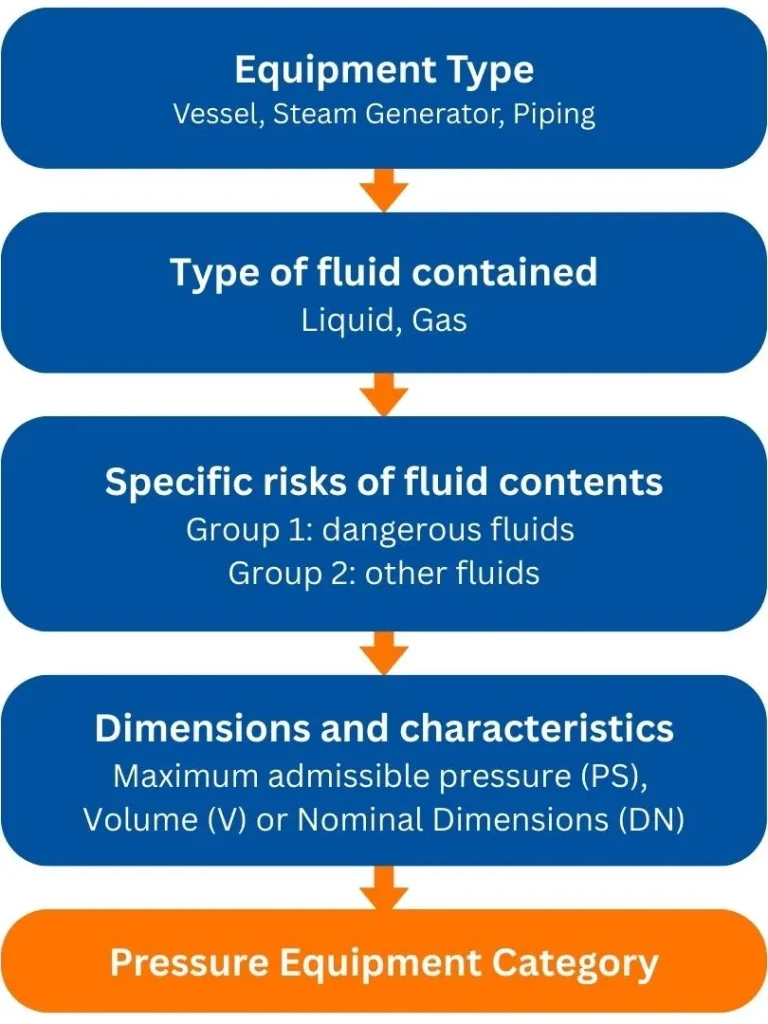
The category of a pressure equipment is based on 4 parameters:
- The equipment type (vessel, steam generator, piping).
- The nature of the fluid (fluid phase and fluid classification – Group 1 or Group 2, see below).
- The maximum allowable pressure (PS).
- The characteristic dimension (volume or DN).
The higher the category of a pressure equipment, the more stringent the conformity assessment procedure is. For more details on the different conformity assessment procedure, please read Annex III of the PED.
Fluid classifications
Group 1: group of dangerous fluids comprising those which are
- explosive;
- flammable; extremely, highly, or where the maximum allowable temperature is higher than the flash point;
- toxic or very toxic;
- combustive;
Group 2: group of any other fluids not included in Group 1.
Pressure Equipment Category Calculators
The following tools can help you determine the category of your pressure equipment:
- Pressure equipment PED category calculator – HPi Verification Services (Ireland) Ltd.
- Simulateur de calcul DESP | Ealico
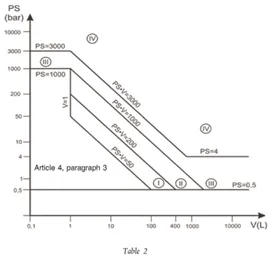
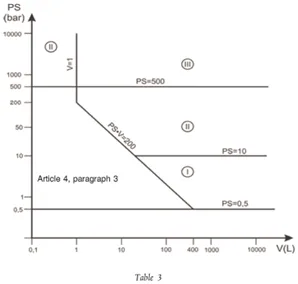
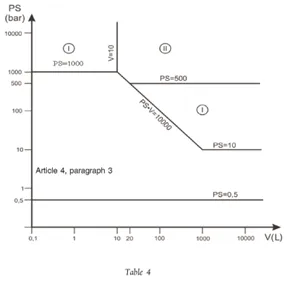
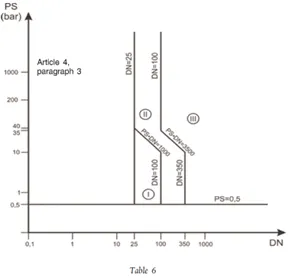
Diagrams illustrating equipment categories
Click below to expand a list of pressure-volume/DN diagrams corresponding to each category as defined in DESP for pressure vessels and pressurisied piping.
View the diagrams
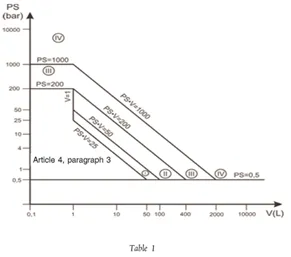
Pressure vessel – Gas Group 1
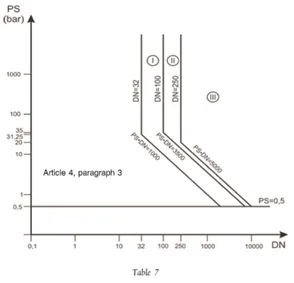
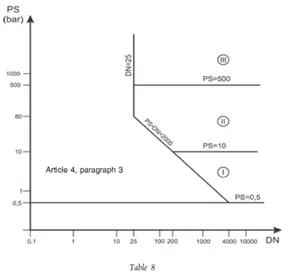
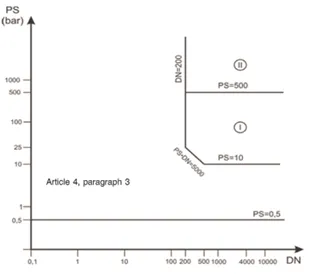
Mandatory Procedures for Pressure Equipment
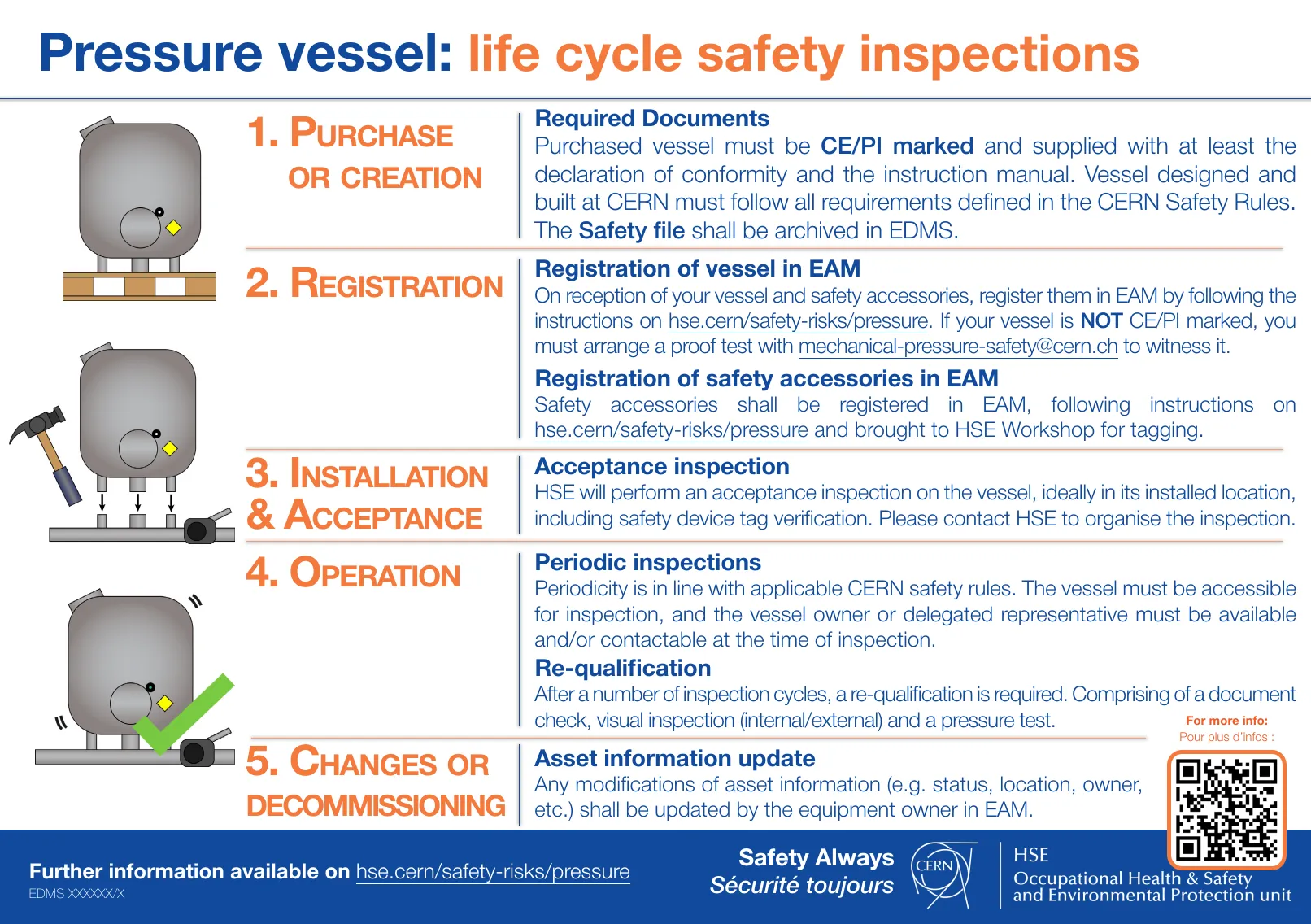
- Registration
As far as possible, avoid using pressure equipment. If you must use it:
- Evaluate the context in which it will be used and the associated hazards.
- Register the equipment using the EAM equipment registration tool.
- Ensure equipment is regularly tested and maintained.
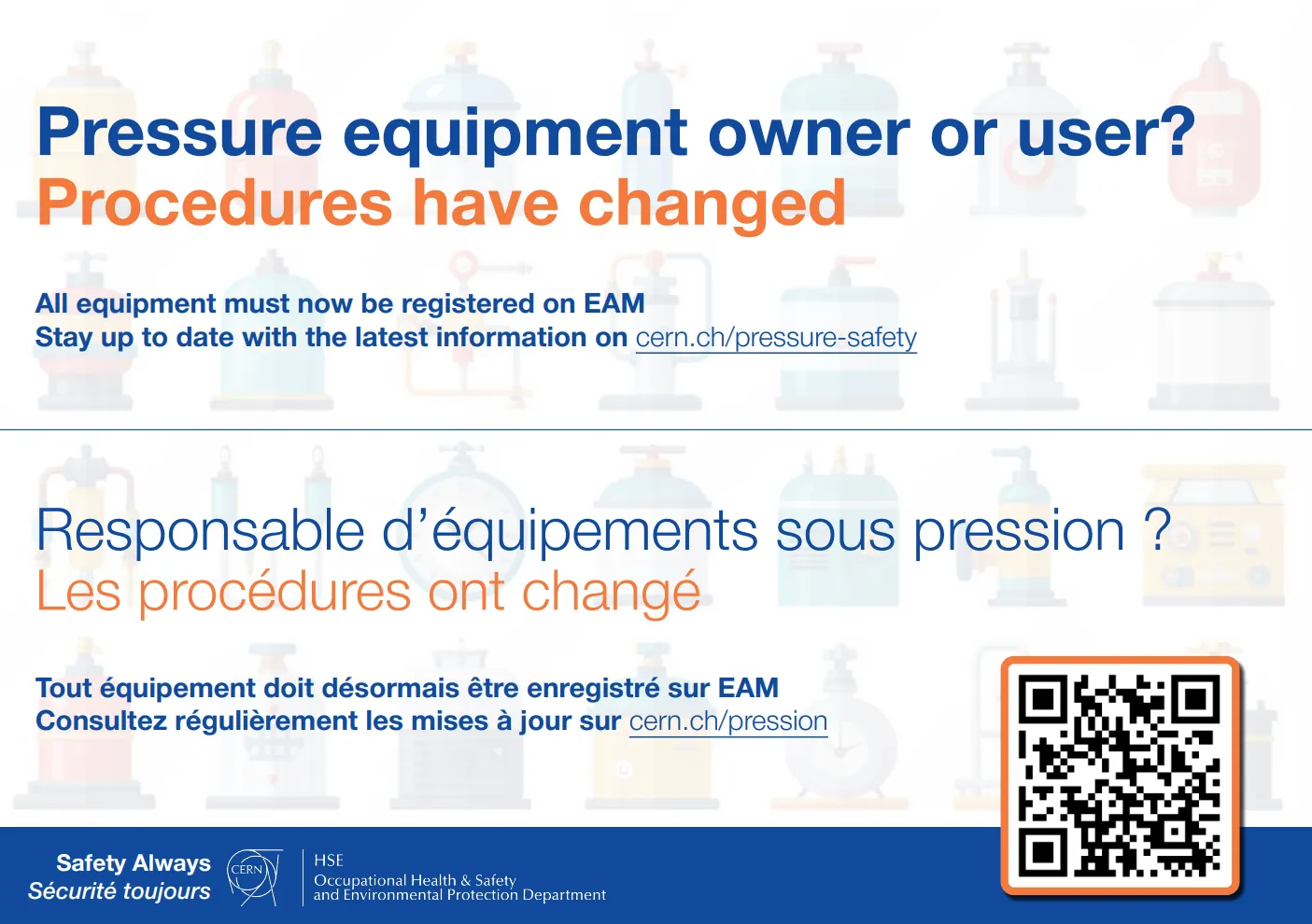
All pressure equipment must be registered in EAM. The video below shows you how to register your pressure equipment on EAM and assign the appropriate periodic inspection schedule, ensuring its safe, continued operation over its lifecycle.
Assets can be managed on EAM Light.
For each type of pressure equipment, a registration procedure is outlined in the guidelines below the video.
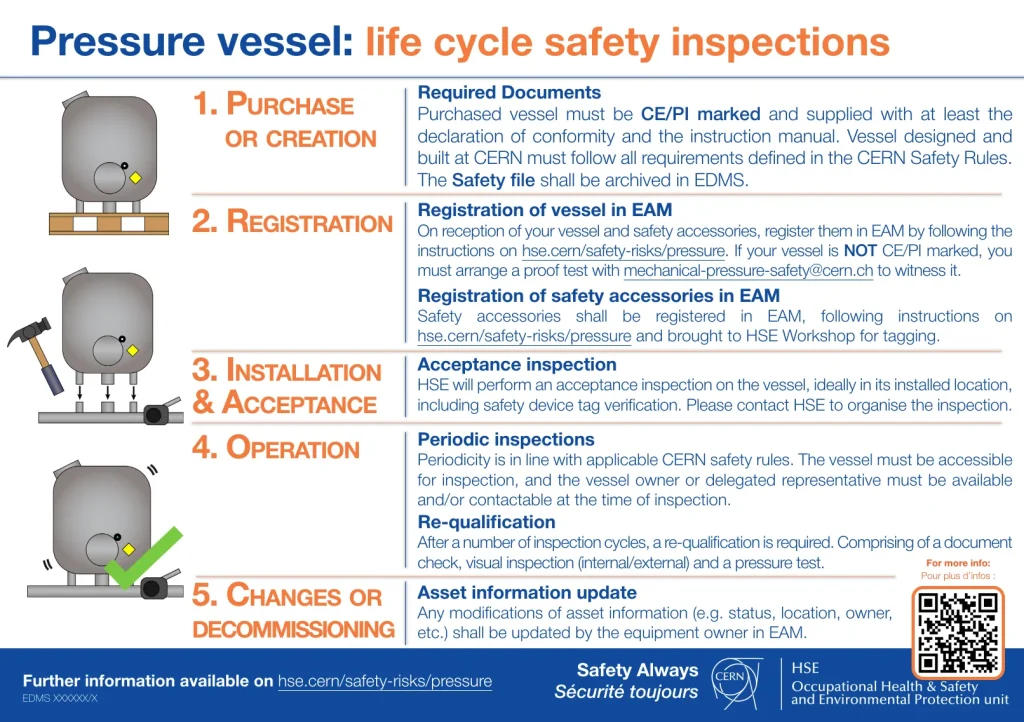
+ Click to see equipment registration guidelines for each equipment type
- Bursting discs registration in EAM | Document 3234712
- Safety valves registration and test request in EAM | Document 3226168
- Pressurised lines registration and pressure test request in EAM | Document 3195225
- Pressure Vessel registration in EAM | Document 3193890
- Refrigerating systems and heat pumps registration in EAM | Document 3310000
- HSE initial acceptance inspection
After registration in EAM, all equipment must undergo an initial acceptance inspection prior to operation. This will be organised with HSE using the dedicated inspection booking tool or by contacting mechanical-pressure-safety@cern.ch.
- Periodic inspection
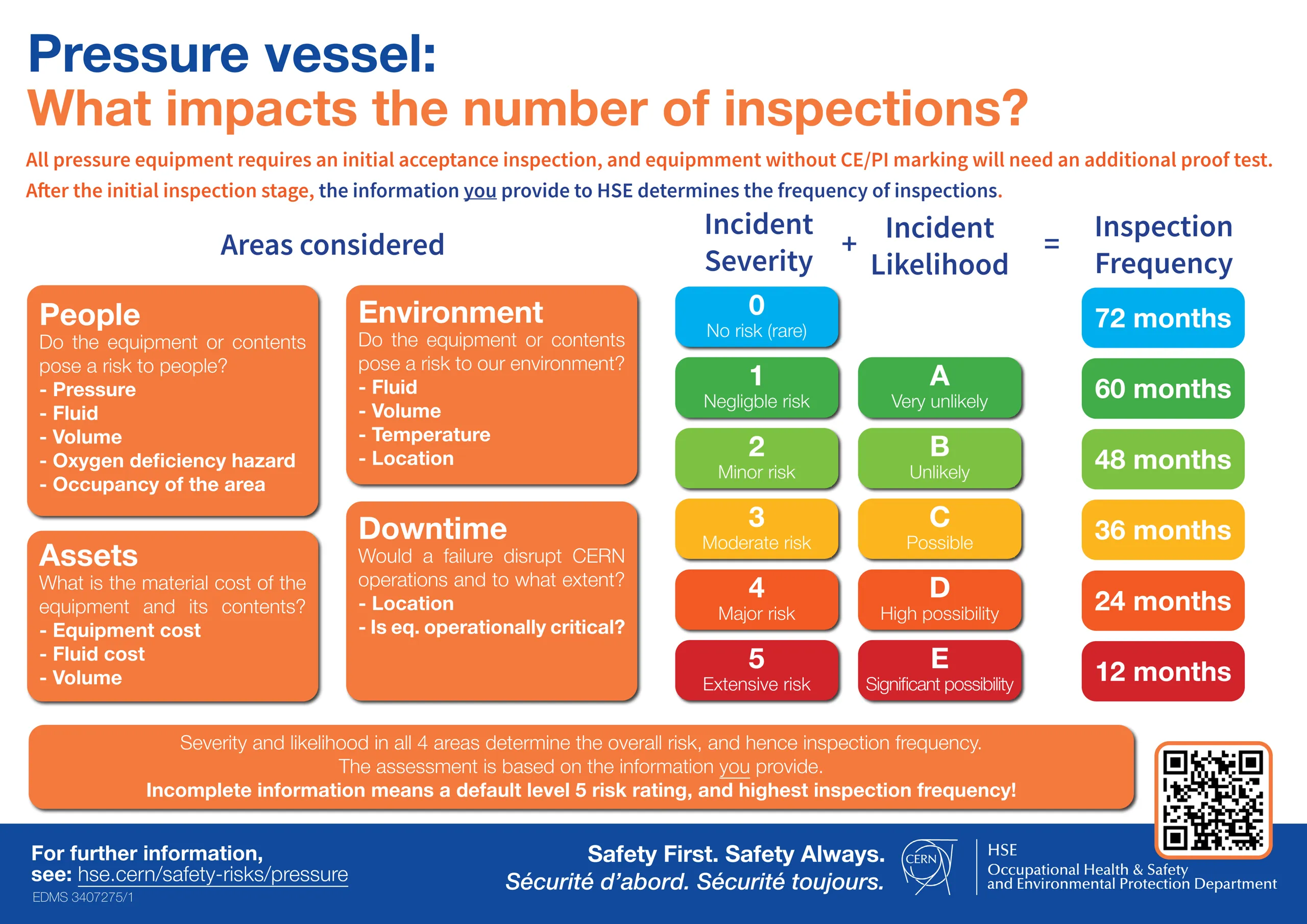
All equipment requiring periodic inspection, as outlined in the above regulatory framework, must undergo a periodic inspection with a frequency determined by HSE according to the equipment’s associated risk.
Equipment owners should prepare equipment for the inspection – make it accessible and stop operations (if needed). Equipment owners (or their representative) should be present or reachable during the inspection.
- Requalification
Requalification is also an inspection but supplemented typically with a pressure test or an acoustic emission test. In case of a pressure test, the equipment should be properly prepared for a (re)pressurisation at the appropriate test pressure (PS x safety coefficient).
In case of doubt on the applicable safety coefficient for the calculation of the test pressure, please contact: mechanical-pressure-safety@cern.ch.
- Pressure equipment asset management
EAM is the asset database used at CERN: eamlight.cern.ch
As an equipment owner, you are responsible for:
- The registration of pressure equipment in the database.
- The attachment of the corresponding technical documentation in the database.
- The update of any information related the pressure equipment in the database (e.g. status change, location change, equipment owner ID change, change of any technical detail).
Useful Contacts
HSE provides advice on the design, manufacturing, installation, inspection and testing procedures of pressure equipment with a view to achieving compliance with the applicable CERN Safety Rules.
This includes:
- Technical advice on the applicable standards to be followed (including requirements in terms of design, testing and technical documentation);
- Providing support in the framework of acceptance inspection by HSE;
- Safety inspections.
For questions regarding pressure safety, contact: mechanical-pressure-safety@cern.ch
For tests of safety accessories, contact the HSE workshop (130/R-009): Cyril Pochet (cyril.pochet@cern.ch) and Olivier Mathieu (olivier.mathieu@cern.ch).