
F-Gas Use Cases: Cooling & Electrical Insulation
Contents:
New Equipment & modification of existing equipment (including retrofit)
When designing or procuring new Equipment, or carrying out modifications to existing Equipment, Equipment responsible persons shall ensure that they use natural gases, low-GWP gases or alternative technologies instead of F-Gases where technically or economically feasible. They shall consult with the F-Gas management team, who will, in particular, review new experimental Equipment (including detectors) and provide support to find mitigation measures to ensure that the most effective and efficient set-up is implemented.
Where F-Gas substitution is not technically or economically feasible, apply the following recommendations while selecting equipment criteria:
| Category | Recommendations |
|---|---|
| Conception or Market Selection |
|
Notify f-gas-management@cern.ch in the following use cases:
- Purchase of new standard cooling Equipment, including the following details:
- selection criteria retained
- type of gas contained
- analysis of market availability, including suppliers’ ranking and whether it is part of a group purchase (including relevant EDMS link).
- New experimental cooling Equipment: as early as possible in the conception/design phase: to discuss alternative solutions.
- New non-sealed electrical Equipment requiring SF6: to discuss alternative solutions.

N.B. Cooling Equipment containing F-Gases with high GWP phase-out started on 1 January 2025 and electrical insulation phase-out of SF6 in switchgears started on 1 January 2026.
Storage of F-Gas bottles/tanks
| Requirements | Information |
|---|---|
Long term storage limited to:
| – Equipment seals deteriorate over time, compromising vessels’ leak-tightness – Transport of filled bottles is only permitted if the expiry date, indicated on the vessel, has not been reached |
Storage Mass limited to:
| For questions please contact f-gas-management@cern.ch |
Storage EAM registration | All Equipment containing F-Gas shall be declared and updated on the EAM platform (EAM or EAM light) according to the Monitoring chapter. |
Leak detection campaign | Leak detection campaigns shall be carried out at least annually on any stored bottles/reservoir and information kept up to date accordingly in EAM |
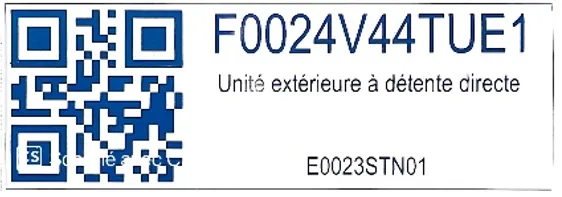
Bottles/vessels labelling | All Equipment shall bear a visible and durable label:
 |
Management & Monitoring
Equipment responsible persons shall ensure that the Equipment under their responsibility is duly registered together with its fluid information in the dedicated platform (EAM or EAM light).
1. Content Registration
After creation of your Equipment on EAM, the F-Gas information content shall be specified in the Fluid Information tab. This tab is visible for every piece of Equipment already registered on the platform.
A step-by-step guide is available under the “Monitoring” chapter.
2. Consumption & Operation Declaration
For each operation involving F-Gas movement, details shall be provided on Work Orders integrating the P-GAS01 taskplan checklist.
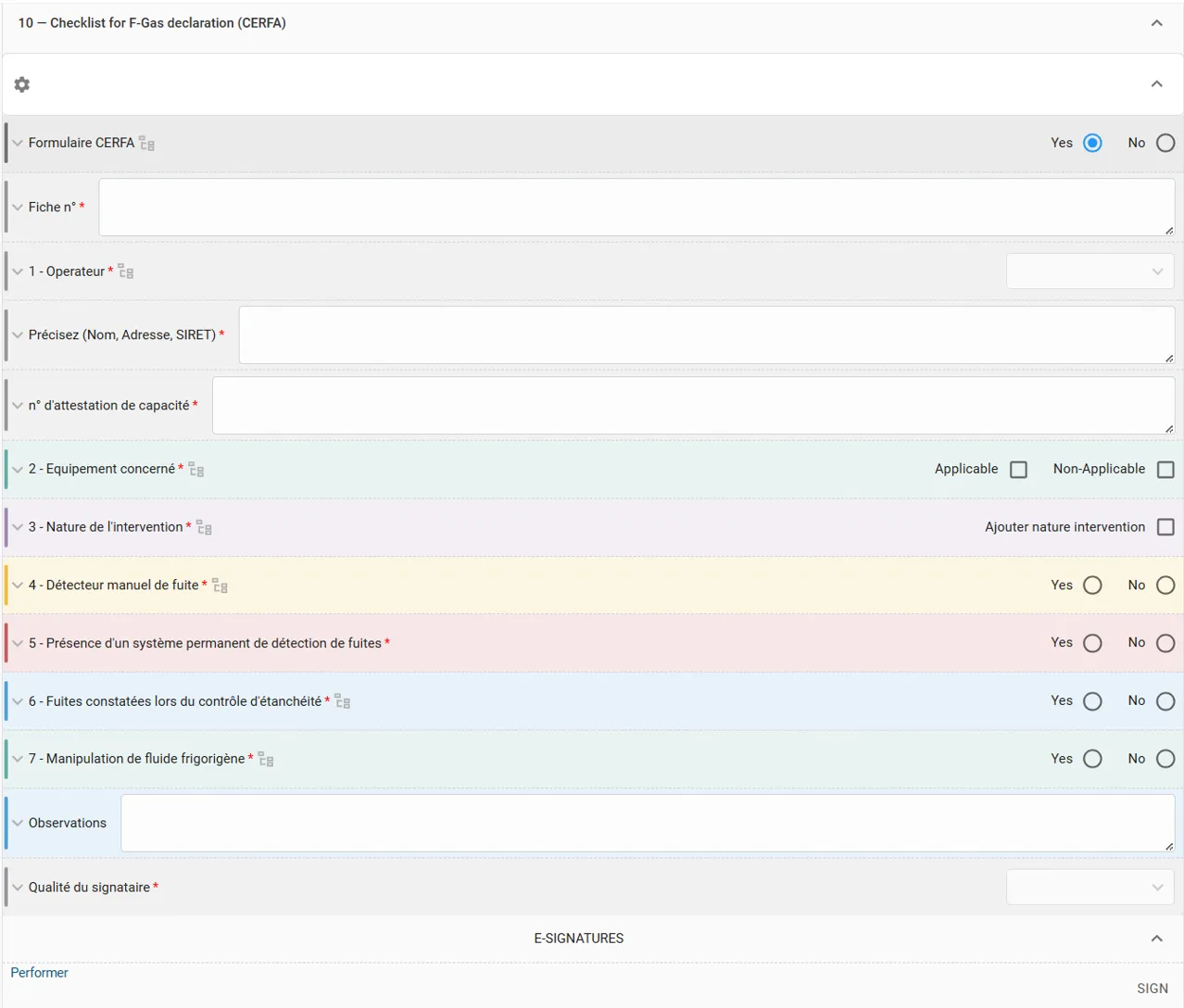
Part of this form is based on the French CERFA form for fluorinated gases operations (CERFA n°15497*04).
Section 1:
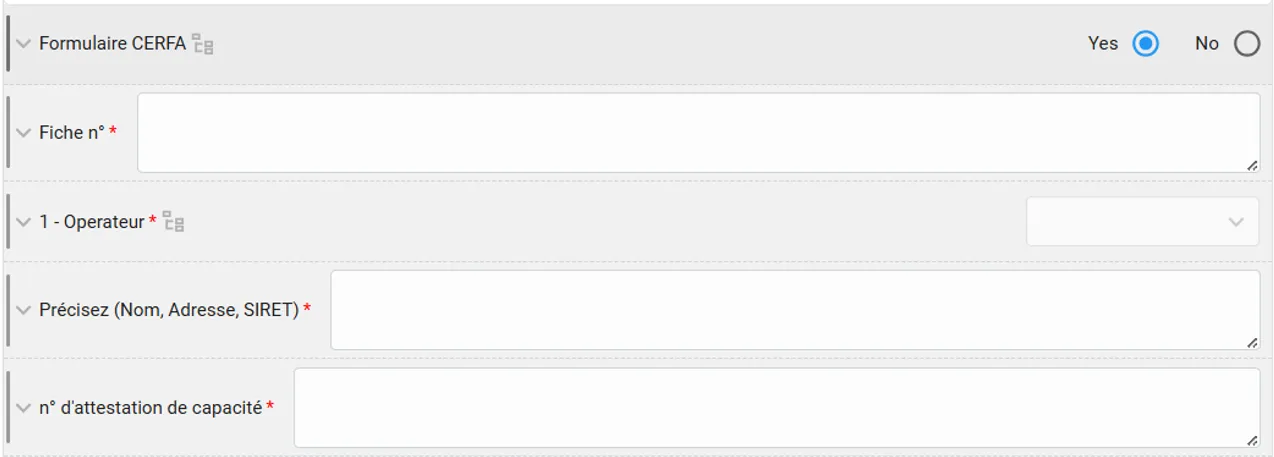
Specify the general information required if the operation requires a CERFA declaration form.
Section 2:

Verify if the current information in the Fluid Information tab is correct. If not, select “A corriger” and specify the correction in the comment field.
Section 3:
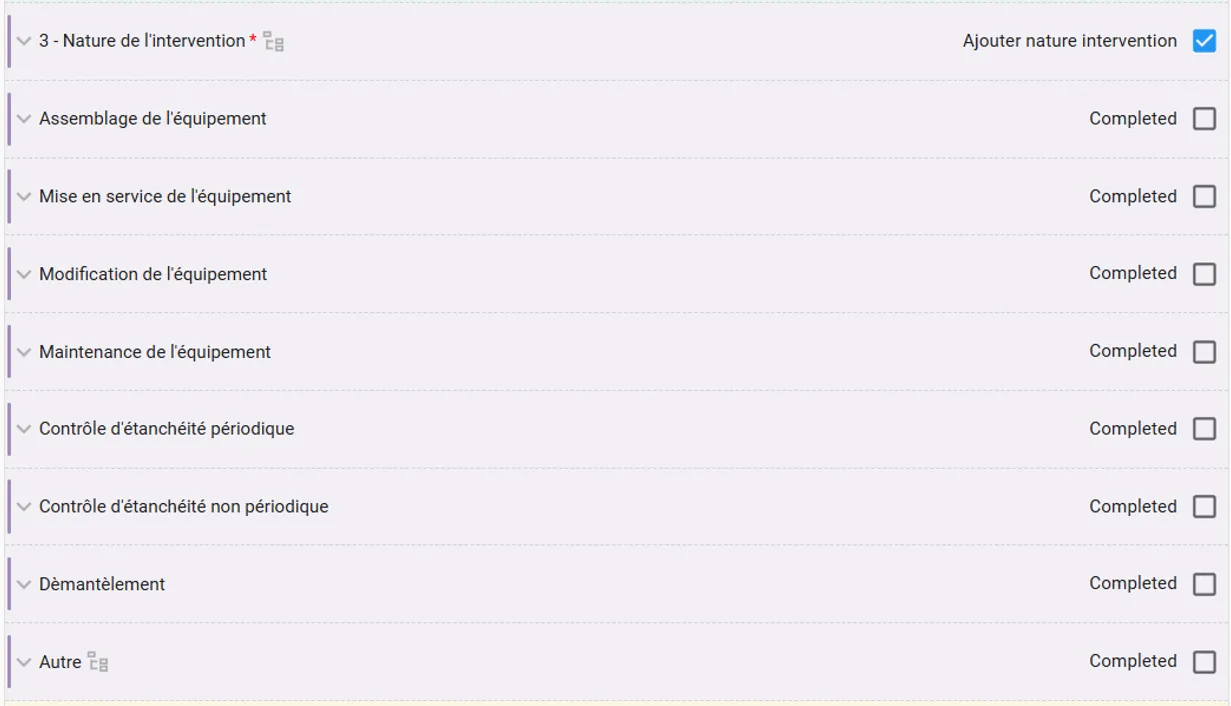
Select the type of operation to be declared in this Work Order.
Section 4:
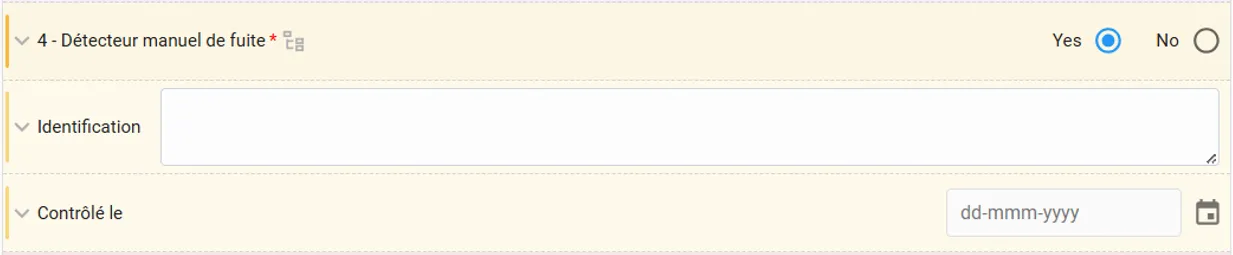
Declare the ID and last control of the manual leak detector, if one is used during the operation.
Section 5:

Specify whether a permanent leak detector is installed near the Equipment.
Section 6:
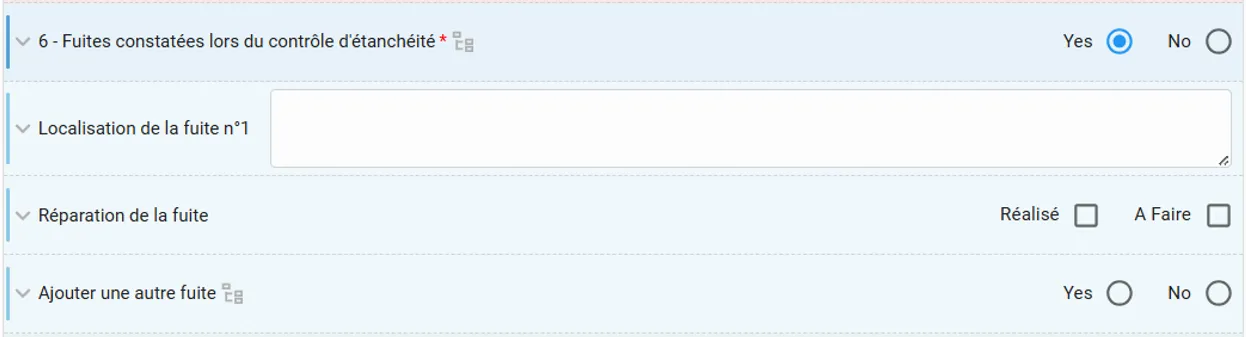
Specify the location(s) of the leaks during the leak test and indicate whether they were repaired.
Section 7:
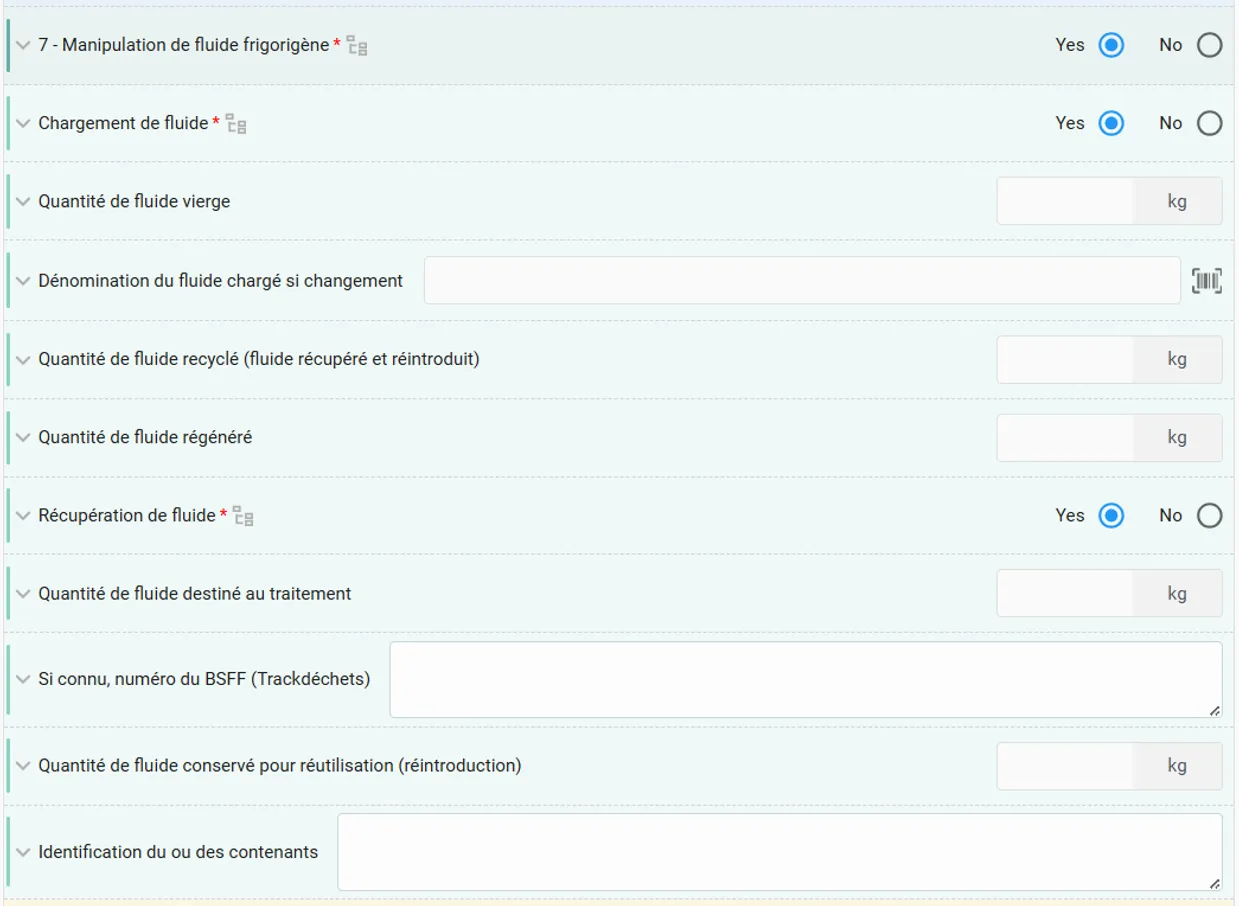
Specify whether the operation involves fluid input or input, as well as the quantity, name and type (virgin/recycled/regenerated).
For the output, provide the following declarations where applicable:
- BSFF (Trackdéchet) number
- Quantity for internal (CERN) usage
- Containers IDs
After completion of the Taskplan, you can generate your N° 15497*04 CERFA on this link by entering your Workorder number. (EN-IM is in the process of adding the link directly on EAM Light).
If you have any additional issue related to completing the form, please contact f-gas-team-management@cern.ch.
For any technical issues, please contact eam.support@cern.ch.
3. Annual validation
Each Equipment owner receives an annual notification in order to validate their stock and F-Gas movement data on the platform.
4. Reporting extraction
F-Gas stock, emission and disposal will be directly extracted from the EAM platform for statistics and monitoring purposes by HSE-ENV.
5. Training
Several training courses to learn more about the EAM platform are available on the learning Hub.
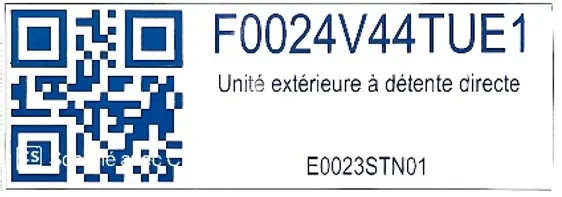
6. Physical label on the Equipment
All Equipment shall display the following EAM information by means of a visible and durable label:
- inventory number
- QR code linking the Equipment to EAM platform
Operation & Maintenance
Reminder: Personnel Handling F-Gases shall:
- complete the dedicated mandatory CERN e-learning course;
- receive CERN practical training if they are Handling research specific Equipment;
- hold the certifications required by applicable regulations in the Host Sates, if any.
Further information can be found in the “Training” chapter.
Only duly trained personnel are authorised to make connections of F-Gases to Equipment. They are therefore responsible for the connections they make and for verifying the integrity of their connections.
Additional instructions:
Instruction | Detail |
|---|---|
Maintenance Procedure | – A maintenance procedure must be defined for each type of Equipment (similar Equipment can share the same procedure) – The procedure must be stored in EDMS and linked to the corresponding Equipment type on the EAM platform – The procedure must at least include the following: o Scheduling of interventions o List of personnel authorised to perform interventions o Leak checks periodicity |
Intervention Register | – Must be managed through EAM Work Orders with HSE Checklist – Any F-Gas movement (e.g. fill, recovery for reuse, disposal: recycling or destruction) must be recorded in the relevant EAM Work Orders |
F-Gas disposal for destruction | F-Gases recovered for destruction must only be removed from CERN sites by designated and trained CERN personnel or by those of the contractor responsible for the Equipment maintenance. |
Leak detection & repair
Leak detection
Regular control of all F-Gas Equipment by trained personnel to detect gas leaks is mandatory. The control frequency for leaks depends on the quantity of tCO2e of F-Gas contained within the Equipment (not applicable to sealed Equipment):
F-Gas quantity (tCO2e) | Frequency of leak control | |
|---|---|---|
No leak detection system | 5 t < X < 50 t | Every year |
50 t < X < 500 t | Every 6 months | |
X > 500 t | Every 3 months | |
Leak detection* system present | 5 t < X <50 t | Every 2 years |
50 t < X < 500 t | Every year | |
X > 500 t | Every 6 months |
Leak repair
Please follow the recommendations applicable to each case:
| Specific Case and reccomendations | ||
|---|---|---|
Safely accessible Equipment | – Repair any leaks as soon as possible to limit emissions | Control the effectiveness of the repair within at least the following month and update the Equipment on the EAM platform accordingly |
Restricted access due to operations or safety risks | – Schedule repairs for the earliest date technically and safely possible | |
Immediate final repair is not possible | – Carry out temporary repair of leaks as soon as technically and safely possible | |
Freshly delivered bottles/containers with defects | – Inform the supplier as soon as possible of any leaks and/or inform CERN store as relevant |
F-Gas incidental/accidental release
Any Equipment responsible person shall develop a clear procedure covering accidental release events. The procedure must be stored in EDMS and cross-linked in the Equipment’s EAM entry.
Similar types of Equipment under the responsibility of the same person can refer to the same procedure.
The procedure shall be reviewed at least yearly in consultation with relevant stakeholders to ensure its practicality. Test drills with stakeholders to guarantee preparedness for quick and effective response shall also be performed.
The procedure shall at least include the following aspects:
| Category | Description |
|---|---|
| Means to stop or minimise gas leaks | List the available means/methods to stop the gas supply to the Equipment/installation/facility or to minimise the gas leak, as soon all safety conditions are met. |
| F-Gas loss Assessment | List possible means/methods to assess the total F-Gas quantity released during the incident/accident. |
| Mandatory Incident Declaration | The incident shall be declared in EDH (Incident Declaration) and shall include at least:
The mandatory EDH Incident Declaration document shall be linked to the Equipment’s EAM entry. |
F-Gas Guidance Menu
CONTACT INFO
If you have any questions regarding the Policy, the Implementation measures, any feedback on this site or specific queries regarding fluorinated gases, contact the CERN F-Gas management team: F-gas-management@cern.ch
Chapter Version 1.0 (See all previous versions on EDMS)