
Safety risks – Lifting equipment
CERN owns and operates a vast stock of lifting equipment which it deploys in a range of activities, both industrial and experimental. Lifting equipment includes all manual and power operated lifting machines, structures such as cranes, winches, hoists etc. Lifting accessories are primarily all the “below hook” equipment such as lifting/spreader beams, slings, shackles, eyebolts etc.
Hazards related to the use of lifting equipment and accessories span from design flaws to operational use across all equipment types, including structural or mechanical failures, incorrect rigging and slinging, unsecured loads, uncontrolled movements, and critical personnel risks such as crushing all the way to lack of training.
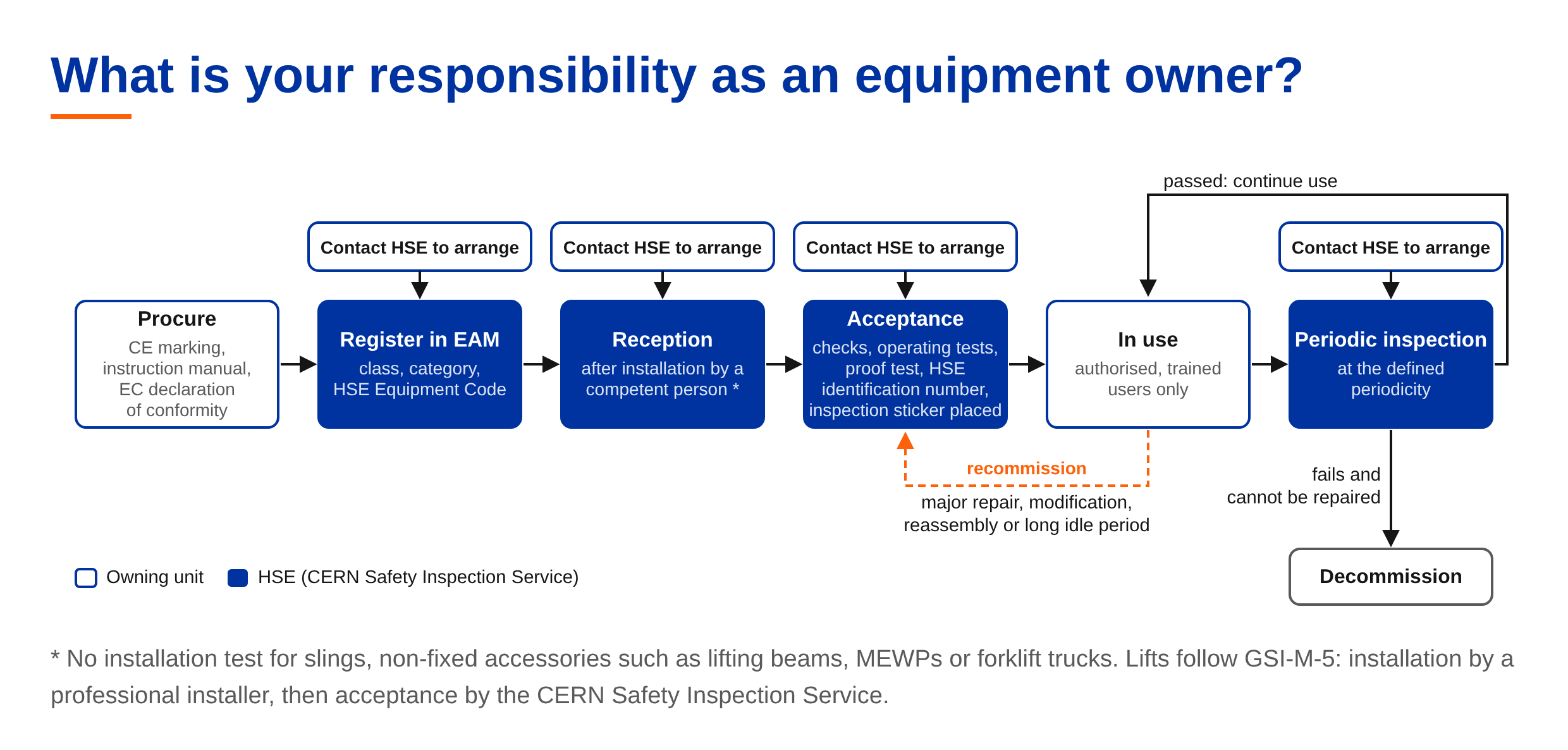
As an equipment owner of lifting equipment, you are responsible for its design, procurement, its pre-use inspections, safe operation (including training of users), maintenance and periodic inspections.
Lifting equipment categories

Lifts
Carriers that move people or goods between fixed levels along rigid Guides, permanently serving a building.

Cranes, Bridge cranes, gantry cranes & power-driven hoists
Powered machines that raise, lower and travel suspended loads across a work area.

Manually Powered lifting equipment
Devices driven directly by human effort, giving controlled lifting without a power supply.

MEWPs, suspended platforms & rail-dependent storage and retrieval equipment
Equipment that puts people or goods up at height, from mobile work platforms to façade cradles and automated warehouse stackers.

Lifting tables, vehicle lifts and tail lifts
Platforms that raise loads or vehicles a short distance for working, servicing or loading.
Industrial trucks
Self-propelled or pedestrian trucks that lift, carry and stack loads on forks or with special attachments.
Lifting accessories categories

Chain slings
Alloy steel chain assemblies with master links and hooks.

Wire rope slings
Steel wire rope with ferrule-secured or spliced eyes, for general-purpose lifts.

Man-made synthetic slings
Lightweight polyester, polyester, polyamide, polypropylene, and HMPE / dyneema slings

Lifting beams and spreaders
Rigid attachments between hook and load that spread the lift points and control sling angles.

Clamps, vacuum lifters and magnets
Attachments that grip the load directly by clamping, suction or magnetism

Schackles, hooks and lifting points
Connecting components that link slings to the hook or attach them to the load.
Regulatory framework
The complete regulatory framework associated with lifting equipment is available at this link. In particular:
- SSI-M-1-1 “Slings and lifting chains”
- SSI-M-1-2 “Cranes, bridge cranes, gantry cranes, and power driven hoists”
- SSI-M-1-3 “Non-fixed load-lifting accessories”
- SSI-M-1-4 “Manually powered lifting equipment”
- SSI-M-1-5 “MEWP, suspended platforms, mast-climbing platforms and rail-dependent storage and retrieval equipment”
- SSI-M-1-6 “Lifting tables, vehicle lifts and tail lifts”
- SSI-M-1-7 “Forklift trucks”
Definitions
For more definitions related to lifting equipment please refer to the EU Machinery Regulation (EU) 2023/1230.
- ‘Lifting equipment’: machinery (including human powered) that moves goods, materials, or persons by significantly changing their height during movement, provided the load is not permanently attached.
- ‘Lifting accessory’: component or item of equipment not attached to the lifting machinery, allowing the load to be held, which is placed between the machinery and the load or on the load itself, or which is intended to constitute an integral part of the load; slings and their components are also regarded as lifting accessories.
- ‘Inspection of lifting equipment for suitability for use’: inspection to check:
- that the lifting equipment is suitable for the work which the user intends to perform with it and with respect to the hazards to which workers are exposed;
- that the intended operations are compatible with the conditions for use of the equipment as defined by the manufacturer
- ‘Inspection of lifting accessories for suitability for use’: inspection to check:
- that the accessory is suitable for the item of lifting equipment for which the user intends to use it and for the work to be performed, and that it is suitable with respect to the hazards to which workers are exposed;
- that the intended operations are compatible with the conditions for use of the accessory as defined by the manufacturer.
- ‘Lifting operation’: means a movement of unit loads consisting of goods and/or persons necessitating, at a given moment, a change of level.
- ‘Working Load Limit (WLL) / Charge maximale d’utilisation (CMU) ’: the maximum load (mass) that an item of lifting equipment is designed to raise, lower or suspend.